Carpentras Stele
Videos
The Carpentras Stele is an Egyptian stele now in Carpentras in southern France. It is the first inscription written in the Phoenician alphabet to have been published, and was identified a century late
The inscription in the Corpus Inscriptionum Semiticarum


The stele as published in 1704.

Carpentras Stela, in CIS II 141 (inscription close up)
Aramaic
Videos
Aramaic is a Northwest Semitic language that originated in the ancient region of Syria and quickly spread to Mesopotamia, the southern Levant, Sinai, southeastern Anatolia, the Caucasus, and Eastern A
Carpentras Stele
…in southern France. It is the first inscription written in the Phoenician alphabet to have been published, and was identified a century later as Aramaic. It is housed in the Bibliothèque Inguimbertine, in a "dark corner" on the first floor. Older Aramaic texts have been found dating from as early as the…

This clay tablet represents a classroom experiment; a teacher imposed a challenging writing exercise on pupils who spoke both Babylonian-Akkadian and Aramaic. The pupils had to use traditional syllabic signs to express the sounds of the Aramaic alphabet. c. 500 BC. From Iraq

One of the Bar-Rakib inscriptions from Sam'al. The inscription is in the Samalian language (also considered a dialect).
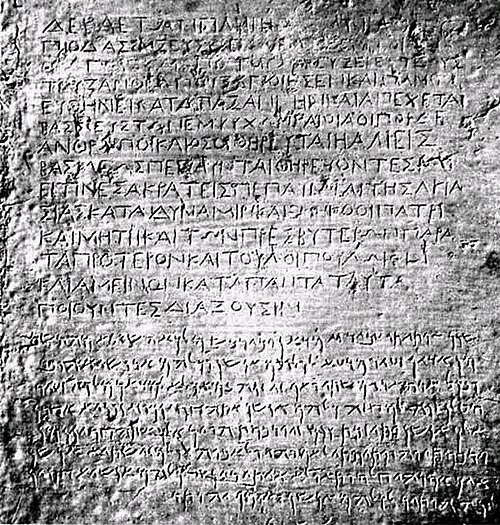
The Kandahar Bilingual Rock Inscription (Greek and Aramaic) by the Indian king Ashoka, 3rd century BC at Kandahar, Afghanistan