Casa da Índia
Videos
The Casa da Índia was a Portuguese state-run commercial organization during the Age of Discovery. It regulated international trade and the Portuguese Empire's territories, colonies, and factories acro

Ribeira Palace (on the right), where the Casa da Índia was headquartered, and its naval yards (on the left), in 1575.

Elmina Castle, built in 1482 on the Portuguese Gold Coast, is the oldest European building in Sub-Saharan Africa. The Casa da Guiné e Mina was charged with managing and taxing Elmina along with the other Portuguese factories on the Gulf of Guinea.

The 2nd Portuguese India Armada, commanded by Pedro Álvares Cabral, discovered Brazil on its way to India.

King Manuel I of Portugal created the Casa da Índia and oversaw a successful expansionist period of the Portuguese Empire in Asia, Africa, and the Americas.
Cantino planisphere
Videos
The Cantino planisphere or Cantino world map is a manuscript Portuguese world map preserved at the Biblioteca Estense in Modena, Italy. It is named after Alberto Cantino, an agent for the Duke of Ferr
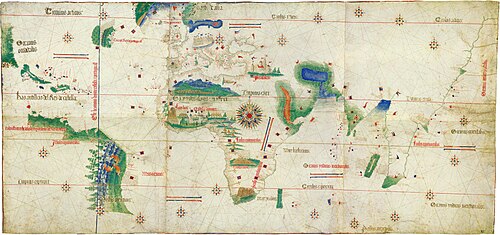
Cantino planisphere (1502), Biblioteca Estense, Modena, Italy

Major wind rose of the Cantino planisphere

The Treaty of Tordesillas line

The rhumb-line construction scheme and geographic lines in the Cantino planisphere. Adapted from Gaspar (2012), Plate 3