Cash (Chinese coin)
Videos
The cash or qian was a type of coin of China and the Sinosphere, used from the 4th century BC until the 20th century, characterised by their round outer shape and a square center hole. Originally cast

Replicas of various ancient to 19th century cast cash coins in various metals found in China, Korea and Japan.

Cash coins minted between 330 BC and AD 1912.

Various cash coins issued during the early Republic of China.

Bronze mould for minting Ban Liang coins, from an excavation in Qishan County, Baoji, Shaanxi.. The mould was used during the Warring States period (475–221 BC) by the State of Qin.
Japanese mon (currency)
Videos
The mon was the currency of Japan from the Muromachi period in 1336 until the early Meiji period in 1870. It co-circulated with the new sen until 1891. Throughout Japanese history, there were many sty
Cash (Chinese coin)
…techniques, such as Yijing divination, as well as traditional Chinese medicine, and feng shui. Currencies based on the Chinese cash coins include the Japanese mon, Korean mun, Ryukyuan mon, and Vietnamese văn. The English term cash, referring to the coin, comes from the Portuguese caixa which was derived from the…

Kan'ei Tsūhō (寛永通宝) coins. The top coins were each worth 4 mon; the middle and bottom coins were worth 1 mon each.
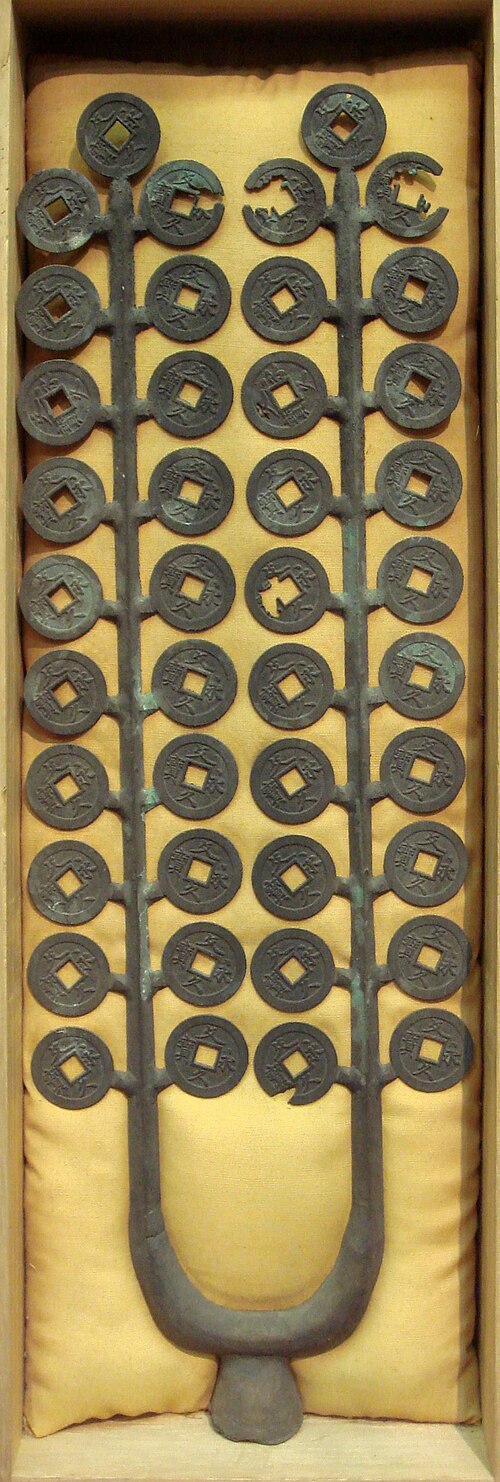
Bunkyū ēhō (文久永宝). Branched ("Edasen" 枝銭) Mon coins of the Bunkyū period. This shows the foundry technique to make the coins: the coins would then be clipped and filed to obtain the final round shape.

An Eiraku Tsūhō (永樂通寳) coin, one of the most commonly circulating coins of the era before the Edo period.

A Hōei Tsūhō (寳永通寳) coin, these were unsuccessfully introduced as a large denomination 10 mon coin in 1708, but failed because of their debased copper content.