Caslon
Videos
Caslon is the name given to serif typefaces designed by William Caslon I in London, or inspired by his work.
William Caslon in an engraved portrait by John Faber the younger

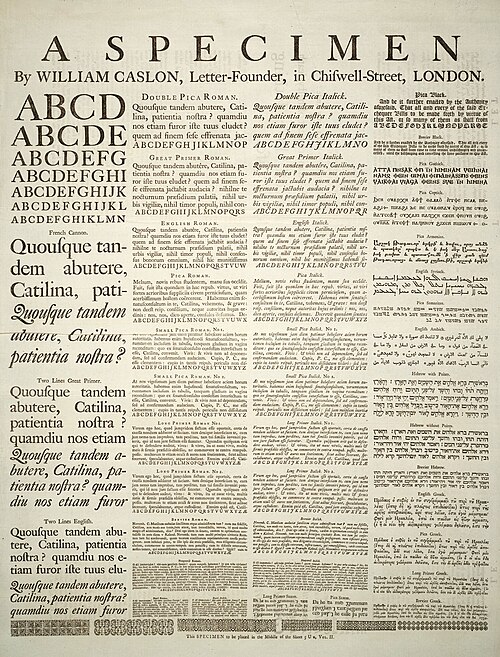
William Caslon's specimen sheet (dated 1734 but actually issued from 1738 onwards). Some of the types shown were not cut by Caslon, most notably the French Canon roman (probably cut by Joseph Moxon).

The Fry type foundry's imitations of first Baskerville (above) and then Caslon type (below), shown in a specimen attached to an edition of The Printer's Grammar, 1787. Mosley describes them as "a very close copy that is not easy to tell from the original."
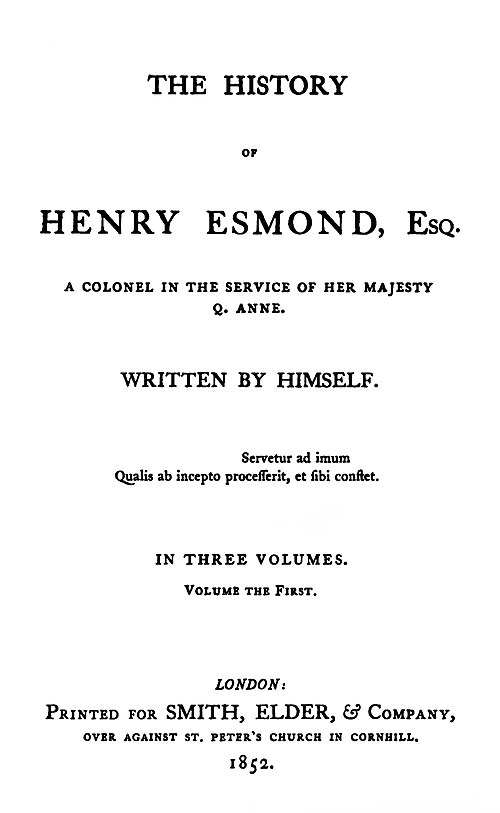
The History of Henry Esmond, a novel by Thackeray written as a fictional memoir. The first edition, of 1852, was printed in Caslon type, then just coming back into fashion. The goal was to achieve a period feel appropriate to its early eighteenth-century setting.
Baskerville
Videos
Baskerville is a serif typeface designed in 1757 by John Baskerville in Birmingham, England, and cut into metal by punchcutter John Handy. Baskerville is classified as a transitional typeface, intende
Caslon
…Caslon's life, notably the romain du roi type of the previous century, the work of Pierre-Simon Fournier in Paris, Fleischmann in Amsterdam and the Baskerville type of John Baskerville in Birmingham that appeared towards the end of Caslon's career, Caslon's type was quite conservative. Johnson notes that his 1764…

The Folio Bible printed by Baskerville in 1763.

Baskerville's first publication, an edition of Virgil. The design shows the smooth, gleaming finish of his paper and minimal title pages.

A slate carved by John Baskerville in his early career offering his services carving tombstones, in blackletter, roman, script and italic. The design is similar to his typography. A recreation in Monotype Baskerville shows the similarities of letterforms.

A detail view of Baskerville's Bible for Cambridge, showing the crispness of the impression.