Cesare Battisti (politician)
Videos
Cesare Battisti was an Italian patriot, geographer, socialist politician and journalist of Austrian citizenship, who became a prominent Irredentist at the start of World War I.
Cesare Battisti in Milan, 1915


Bust of Cesare Battisti by Adolfo Wildt at the Bolzano Victory Monument

This image was used in the work The Last Days of Mankind by Karl Kraus, which has been described as the Austrian national drama, symbolic for the oppression in Austria, particularly towards non-German people. Depicted is the irredentist Reichsrat and provincial assembly deputy Cesare Battisti after his execution by the for Austria typical garrote (1916) in the moat of the Castle of Trento, together with the infamous executioner Josef Lang.

Battisti is remembered at Via Cesare Battisti, near Piazza Venezia, in Rome.
Garrote
Videos
A garrote or garrotte, or garrote vil, is a weapon and a method of capital punishment. It consists of a handheld ligature of chain, rope, scarf, wire, or fishing line, used to strangle a person.
Cesare Battisti (politician)
…Army uniform, but the judge denied his request and instead procured for him some shabby civilian clothes. Dressed in these, he was executed (hanged and garrotted) the same day, the brutality of which was increased by the fact that executioner Josef Lang botched the job so that Battisti actually was hanged twice…

From the torture museum of Freiburg im Breisgau
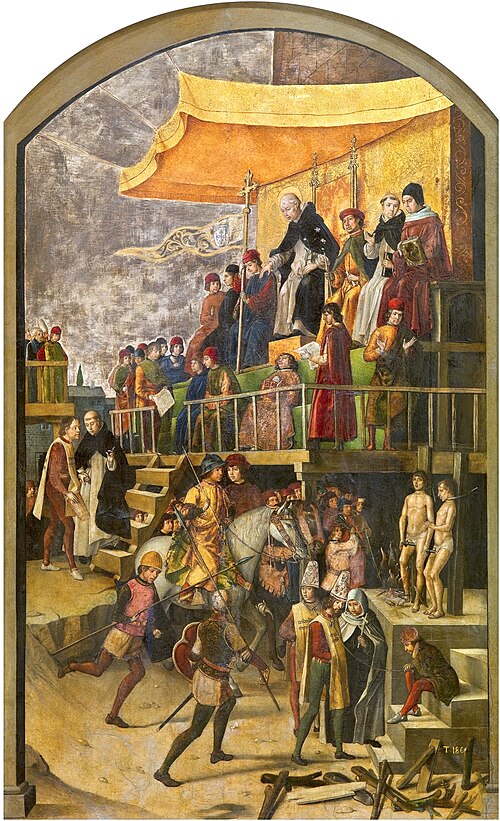
In this 15th-century depiction of the burning of Albigensians after an auto da fé, the condemned had been garrotted previously. It is one of the first depictions of a garrotte. Pedro Berruguete, Saint Dominic Presiding over an Auto-da-fé.

Execution by garrotte in Spain

Execution by garrotte of a murderer in Barcelona