Chariots in ancient China
Videos
The ancient Chinese chariot was used as an attack and pursuit vehicle on the open fields and plains of ancient China from around 1200 BCE. Chariots also allowed military commanders a mobile platform from which to control troops while providing archers and soldiers armed with dagger-axes increased mobility. They reached a peak of importance during the Spring and Autumn period, but were largely superseded by cavalry during the Han dynasty.

A Chinese chariot (c. 400 BCE)

War chariots at Shang Dynasty Yinxu ruins. Shang chariots were introduced around 1200 BCE through the northern steppes, probably from the area of the Deer stones culture.

Warring States chariot burial pit

Powerful landlord in chariot. Eastern Han 25–220 CE. Anping, Hebei.
Han–Xiongnu War
Videos
The Han–Xiongnu War, also known as the Sino–Xiongnu War, was a series of military conflicts fought over two centuries between the Chinese Han Empire and the nomadic Xiongnu confederation, although extended conflicts can be traced back as early as 200 BC and ahead as late as 188 AD.

Emperor Wu dispatching the diplomat Zhang Qian to Central Asia, Mogao Caves mural, 8th century

Emperor Wu of Han
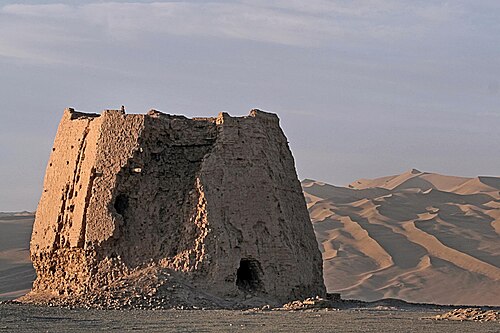
The ruins of a Han rammed-earth watchtower in Dunhuang

Painted ceramic statues of Chinese cavalrymen and infantrymen, from the Western Han period (202 BC – 9 AD)