Cherokee–American wars
Videos
The Cherokee–American wars, also known as the Chickamauga Wars, were a series of raids, campaigns, ambushes, minor skirmishes, and several full-scale frontier battles in the Old Southwest from 1776 to
The Cherokees are Coming!, an illustration depicting a scout warning the residents of Knoxville, Tennessee, of the approach of a large Cherokee force in September 1793


A commander of Fort Patrick Henry sent Henry Timberlake as a token of friendship after the Anglo-Cherokee War. Timberlake later took three Cherokee to London, 1763.

An 1851 history painting portrays Boone's first crossing of the Cumberland Gap with a party of settlers in 1773. (Daniel Boone Escorting Settlers through the Cumberland Gap, by George Caleb Bingham, oil on canvas, 1851)

Artist's impression of the capture of Jemima Boone by Cherokee Indians in 1776, painted by German-American artist Charles Ferdinand Wimar in 1853.
Cherokee
Videos
The Cherokee people are one of the Indigenous peoples of the Southeastern Woodlands of the United States. Prior to the 18th century, they were concentrated in their ancestral homelands, living in town
Sequoyah, creator of the Cherokee syllabary, as painted by Henry Inman, c. 1830


Great Smoky Mountains
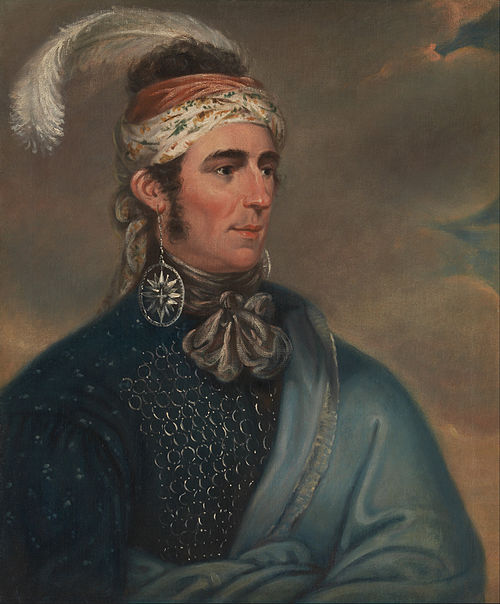
Portrait of Major John Norton (Mohawk chief) as Mohawk Chief Teyoninhokarawen by Mather Brown, ca. 1805. Yale Center for British Art (his father was a Cherokee while John Norton adopted by the Mohawks)