Chinese Empire
Videos
The Chinese Empire, also known as Imperial China, Empire of China, Celestial Empire, or simply China, was an imperial realm that spanned much of East, North, Central, South and Southeast Asia from the 3rd century BC to the 20th century.


Liu Bang in Portraits of Famous Men, c. 1900. His reign launched China's first golden age.

Army of Northern Wei terracotta soldiers in Xianbei uniform, tomb of Sima Jinlong, 484 CE.
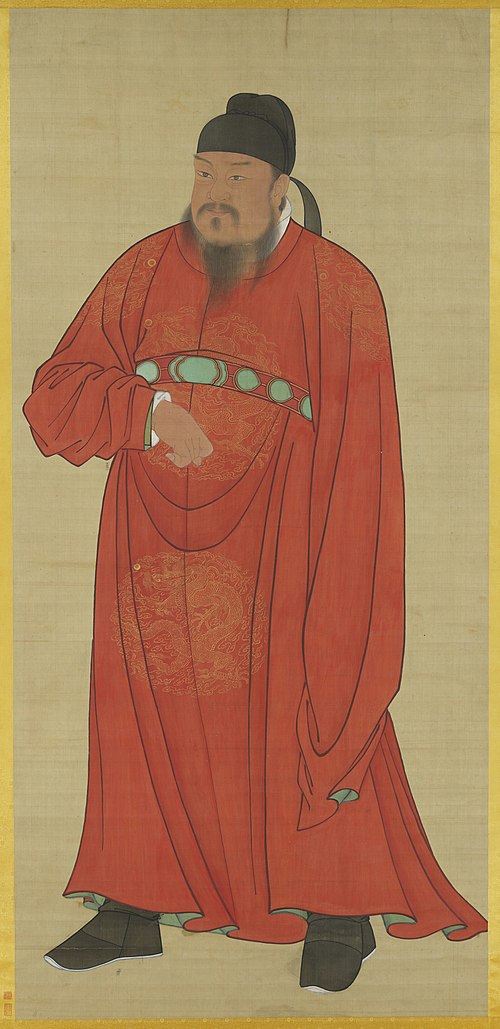
Portrait painting, dating to the Ming dynasty (1368–1644), depicting the first Tang emperor Gaozu (born Li Yuan, 566–635)
Qin dynasty
Videos
The Qin dynasty was the first dynasty of Imperial China. It is named for its progenitor state of Qin, which was a fief of the confederal Zhou dynasty which had endured for over five centuries—until 221 BC, when it assumed an imperial prerogative following its complete conquest of its rival states, a state of affairs that lasted until its collapse in 206 BC. It was formally established after the conquests in 221 BC, when Ying Zheng, who had become king of the Qin state in 246, declared himself to be "Shi Huangdi", the first emperor.

Territory controlled by the Qin dynasty c. 210 BC

Stone rubbing of a Han dynasty carved relief depicting Jing Ke's assassination attempt on Qin Shi Huang (right) holding an imperial jade disc. Jing Ke (left) is held by a court physician (background). The dagger is stuck in the pillar. A soldier (far right) rushes to save his emperor.

Excavation of the western platform

A gate of the Palace