Chinese Rites controversy
Videos
The Chinese Rites controversy was a dispute among Catholic missionaries over the religiosity of Confucianism and Chinese rituals during the 17th and 18th centuries. The debate discussed whether Chines
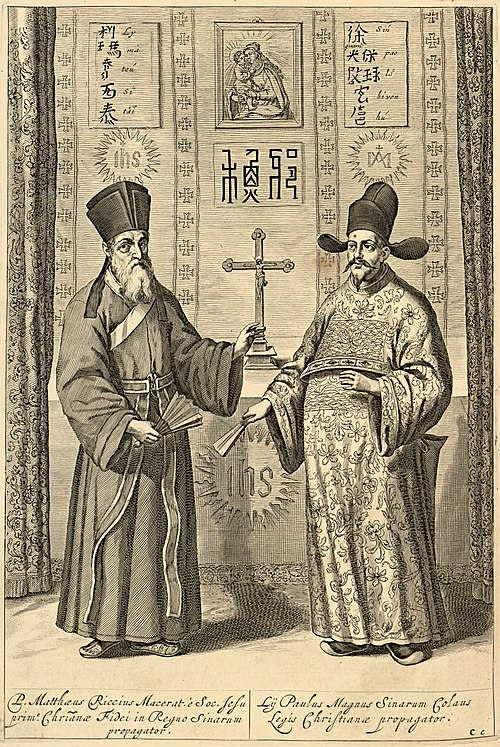
Matteo Ricci (left) and Xu Guangqi (right) in the Chinese edition of Euclid's Elements (Chinese: 幾何原本) published in 1670

The Jesuits of the Jesuit China missions made efforts to adopt Chinese customs. Here Nicolas Trigault (1577–1628) in Chinese costume, by Peter Paul Rubens.

The Kangxi Emperor with a Jesuit astronomer, Adam Schall. "Tapisserie de Beauvais", 1690–1705.

Confucius, Philosopher of the Chinese, or, Chinese Knowledge Explained in Latin, compiled by Philippe Couplet and three other Jesuits and printed at Paris in 1687
Matteo Ricci
Videos
Matteo Ricci was an Italian Jesuit who served in the court of Ming dynasty China and one of the founding figures of the Jesuit China missions. He created the Kunyu Wanguo Quantu, a 1602 world map writ
Chinese Rites controversy
…to argue, in the case of Japan, for an adaptation of Christian customs to the societies of Asia, through his Résolutions and Cérémonial. In China, Matteo Ricci reused the Cérémonial and adapted it to the Chinese context. At one point the Jesuits even started to wear the gown of Buddhist monks, before adopting…

Chinese portrait of Ricci from 1610

The statue of Ricci in downtown Macao, unveiled on 7 August 2010, the anniversary of his arrival on the island

Matteo Ricci's way from Macau to Beijing

Matteo Ricci Museum in Zhaoqing located on the site of the Catholic Church he helped found called Xianhua Temple (仙花寺)