Chinookan peoples
Videos
Chinookan peoples include several groups of Indigenous people of the Pacific Northwest in the United States who speak the Chinookan languages. Since at least 11,500 BCE, Chinookan peoples and their an

Chinook people meet the Corps of Discovery on the Lower Columbia, October 1805 (by Charles M. Russell, 1905)

Chinook child undergoing process of flattening the head.

Cathlapotle Plankhouse, a full-scale replica of a Chinook-style cedar plankhouse erected in 2005 at the Ridgefield National Wildlife Refuge; the original and thirteen others like like it housed more than 1200 Chinook people at Cathlapotle village in 1806

Illustration of the interior of a Chinookan plankhouse
Artificial cranial deformation or modification, head flattening, or head binding is a form of body alteration in which the skull of a human being is deformed intentionally. It is done by distorting th
Chinookan peoples
…thievery on behalf of their masters. The latter refrained from such practices as unworthy of high status. The elite of some tribes had the practice of head binding, flattening their children's foreheads and the top of the skull as a mark of social status. They bound the infant's head under pressure between boards…

Elongated skull excavated in Samarkand (600–800 CE), Afrasiab Museum of Samarkand

Portrait of a Yuezhi prince from Khalchayan, circa 1st century CE, showing elongated skull.

Portrait of Alchon Hun king Khingila, from his coinage, c. 450 CE
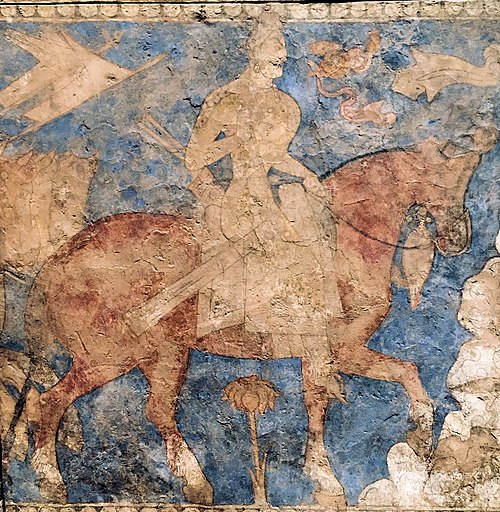
Legendary Iranian king Rostam, depicted in this 7th-century CE mural at Panjikent, Sogdia, with an elongated skull in the fashion of the Alchon Huns.