Chromoxylography was a colour woodblock printing process, popular from the mid-19th to the early-20th century, commonly used to produce illustrations in children's books, serial pulp magazines, and cover art for yellow-back and penny dreadfuls. The art of relief engraving and chromoxylography was perfected by engravers and printers in the 19th century, most notably in Victorian London by engraver and printer Edmund Evans who was particularly good with the process, producing a wide range of hues and tones through color mixing. Chromoxylography was a complicated technique, requiring intricate engraving and printing for the best results. Less expensive products, such as covers for pulp magazines, had to be produced with few colours, often only two or three, whereas more intricate and expensive books and reproductions of paintings used as many as a dozen or more colors. For each colour used, a separate woodblock had to be carved of the image being reproduced.
Walter Crane's Absurd ABC double-spread with deep black background
1896 children's magazine cover showing thicker hatchings. The colour register slipped causing the print to blur.
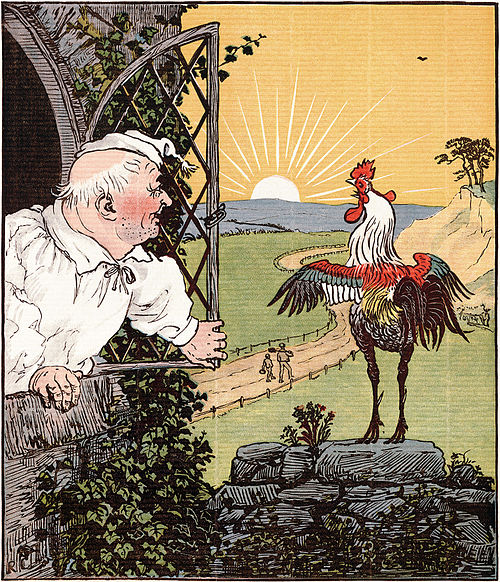
Image from Randolph Caldecott's "The House that Jack Built"
Edmund Evans was an English wood-engraver and colour printer during the Victorian era. He specialized in full-colour printing, a technique which, in part because of his work, became popular in the mid-19th century. He employed and collaborated with illustrators such as Walter Crane, Randolph Caldecott, Kate Greenaway and Richard Doyle to produce what are now considered to be classic children's books. Little is known about his life, although he wrote a short autobiography before his death in 1905 in which he described his life as a printer in Victorian London.
Illustration from "The House that Jack Built" in The Complete Collection of Pictures & Songs; engraving and printing by Edmund Evans, illustration by Randolph Caldecott (1887)
This 1853 title page for the Illustrated London Almanac is an example of Evans' engraving work. The illustration is designed by Myles Birket Foster.
"Death of the Kingmaker" from Chronicle of England, colour wood-engraving by Evans, illustration by James Doyle (1864). Evans used as many as ten colour blocks for the 80 prints in the volume.
In Fairyland, a Series of Pictures from the Elf-World engraving, illustrated by Richard Doyle, coloured and printed in 1870 by Evans.