Cicero
Videos
Marcus Tullius Cicero was a Roman statesman, lawyer, scholar, philosopher, orator, and writer who tried to uphold optimate principles during the political crises of the Roman Republic that led to the
First-century AD bust of Cicero at the Capitoline Museums, Rome


Arpino, Italy, birthplace of Cicero

The Young Cicero Reading by Vincenzo Foppa (fresco, 1464), now at the Wallace Collection in London

Cistophorus minted by Cicero in Apamea Cibotus in 51–50 BC, while serving as proconsul of Cilicia.
Catilinarian conspiracy
Videos
The Catilinarian conspiracy, sometimes Second Catilinarian conspiracy, was an attempted coup d'état by Lucius Sergius Catilina to overthrow the Roman consuls of 63 BC – Marcus Tullius Cicero and Gaius
Cicero
…orator and successful lawyer, Cicero believed his political career was his most important achievement. During his consulship in 63 BC, he suppressed the Catilinarian conspiracy; however, because he had summarily and controversially executed five of the conspirators without trial, he was exiled in 58 but recalled the next year…
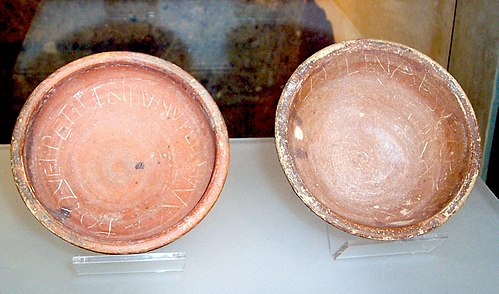
Bowls containing food distributed in electoral canvasses. The bowl to the right was commissioned by Lucius Cassius Longinus and distributed in support of Catiline's consular candidacy in 63 BC. The bowl on the left was distributed by Marcus Porcius Cato in a coeval campaign for the plebeian tribunate.

A denarius minted by Lucius Scribonius Libo in 62 BC. The portrayal of Bonus Eventus on the obverse likely commemorates the repression of Catiline's conspiracy.

A denarius minted by Lucius Aemilius Paullus in 62 BC commemorating Catiline's defeat. It depicts the goddess Concordia, on the left. Berry 2020, p. 54 argues that Paullus attempted to connect Catiline's defeat to peace.