Class A airfield
Videos
Class A airfields were World War II military installations constructed to specifications laid down by the British Air Ministry Directorate General of Works. Intended for use by heavy bombers and trans
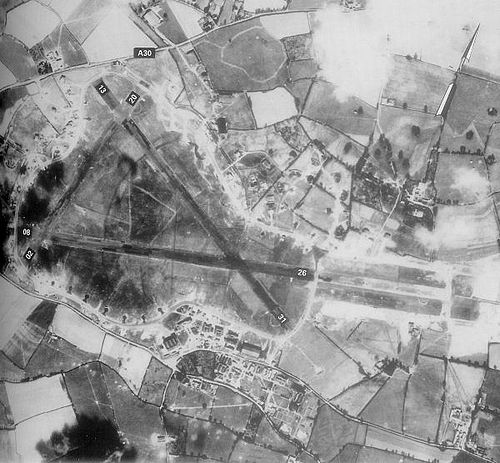
Aerial view of RAF Exeter airfield on 20 May 1944, showing the triangular layout of the runways and the encircling (light-coloured) perimeter track.

The runways at RAF Beaulieu.
RAF Polebrook
Videos
Royal Air Force Polebrook or more simply RAF Polebrook is a former Royal Air Force station located 3.5 miles east-south-east of Oundle, at Polebrook, Northamptonshire, England. The airfield was built

Boeing B-17C Flying Fortress (RAF Fortress I) of 90 Squadron (WP) - August 1941. After their use by the RAF, four Fortress I's were later sent to the Middle East, where, until May 1942, they undertook night attacks against enemy positions at Benghazi and Tobruk. In February to April 1942, five of the remaining Fortress I's in Europe were transferred to RAF Coastal Command.

RAF Polebrook control tower, 20 March 1945. Note the use of a B-17 nose plexiglass. Also shows Signals Square

Boeing B-17E Fortress Serial 41-2578. This aircraft was the oldest and longest serving B-17 in the Eighth Air Force. While with the 97th Bomb Group on 17 August 1942, this was the lead aircraft in the first Eighth Air Force heavy bombing mission. Later, this aircraft was used for training combat replacement crews with the 11th Combat Crew Replacement Unit at RAF Bovingdon until 1945.

Boeing B-17G-95-BO Fortress 43-38846, 351st Bombardment Group