Classical Chinese poetry
Videos
Classical Chinese poetry is traditional Chinese poetry written in Classical Chinese and typified by certain traditional forms, or modes; traditional genres; and connections with particular historical
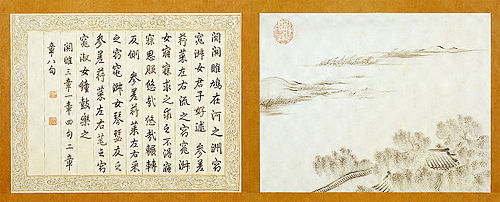
Shijing first verse by Qing Qianlong Emperor. Qing dynasty.

A Han dynasty terracotta horse head (1st–2nd century CE)

A Ming dynasty portrayal of Cao Cao

Seven Sages of the Bamboo Grove from a picture from the brick wall of a tomb located near the Eastern Jin capital (modern Nanjing, China)
Classic of Poetry
Videos
The Classic of Poetry, also Shijing or Shih-ching, translated variously as the Book of Songs, Book of Odes, or simply known as the Odes or Poetry, is the oldest existing collection of Chinese poetry,
Classical Chinese poetry
…periods, such as the poetry of the Tang dynasty. The existence of classical Chinese poetry is documented at least as early as the publication of the Classic of Poetry (Shijing). Various combinations of forms and genres have developed over the ages. Many or most of these poetic forms were developed by the end of the…

The traditional score of 'Fishhawk' included in the Wei Family Music Score (Gishi Gakufu) (1768, Japan)

Guan ju (poem number 1 from the Classic of Poetry) carved into a rock. The four-character verses are inscribed from top to bottom.

Part of the Kǒngzǐ Shīlùn (孔子詩論), an early discussion of the Classic of Poetry