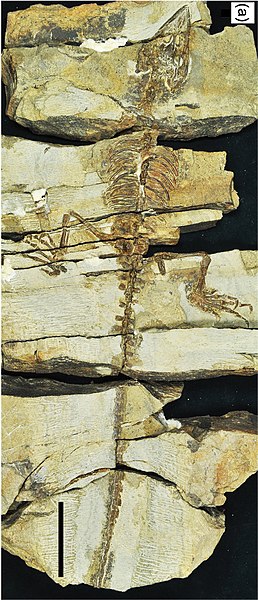
Coeruleodraco is an extinct genus of choristoderan known from the Late Jurassic (Oxfordian) Tiaojishan Formation in China. Coeruleodraco is significant as the most complete Jurassic choristodere taxon, as the only other named Jurassic choristodere Cteniogenys is based on fragmentary remains. Although similar to Philydrosaurus in its proportions and postcranial characters, it is distinct in retaining several apparently plesiomorphic characters, including a short snout, paired external nares and an open lower temporal fenestra.
Coeruleodraco
CT scan of the skull of the holotype
Life reconstruction of C. jurassicus compared to a human hand
Choristodera is an extinct order of semiaquatic diapsid reptiles that ranged from the Middle Jurassic, or possibly Triassic, to the Miocene. Choristoderes are morphologically diverse, with the best known members being the crocodile-like neochoristoderes such as Champsosaurus. Other choristoderans had lizard-like or long necked morphologies. Choristoderes appear to have been confined to the Northern Hemisphere, having been found in North America, Asia, and Europe, and possibly also North Africa. Choristoderes are generally thought to be derived neodiapsids that are close relatives or members of Sauria.
Image: Philydrosaurus proseilus NMNS
Image: Ikechosaurus sp. NMNS (cropped)
Skeleton of Champsosaurus natator at the Canadian Museum of Nature
Skeletons of Hyphalosaurus, in the collections of the Beijing Museum of Natural History (BMNH)