Colony of Virginia
Videos
The Colony of Virginia was a British colonial settlement in North America from 1606 to 1776. The first effort to create an English settlement in the area was chartered in 1584 and established in 1585;

The Indian massacre of 1622, depicted in a 1628 woodcut

Cover to a history of the Plantation of Virginia between 1612 and 1624, compiled by its planters

Red line showing the boundary between the Virginia Colony and Tributary Indian tribes established by the Treaty of 1646. The red dot indicates Jamestown, the capital of the Virginia Colony.

Lines showing the legal treaty frontiers between the Virginia Colony and Indian Nations in various years and today's state boundaries. Red: Treaty of 1646. Green: Treaty of Albany (1684). Blue: Treaty of Albany (1722). Orange: Proclamation of 1763. Black: Treaty of Camp Charlotte (1774). The area west of this line in present-day Southwest Virginia was ceded by the Cherokee in 1775.
Thirteen Colonies
Videos
The Thirteen Colonies were the British colonies on the Atlantic coast of North America which broke away from the British Crown in the American Revolutionary War, and joined to form the United States o
Colony of Virginia
…in 1775, before the Declaration of Independence was officially adopted, the Virginia Colony became the Commonwealth of Virginia, one of the original thirteen states of the United States, adopting as its official slogan "The Old Dominion". The entire modern states of West Virginia, Kentucky, Indiana, Illinois…

The Thirteen Colonies of British America: (dark red): New England Colonies (red-brown): Middle Colonies (brown): Southern Colonies

Fort George and New York, c. 1731
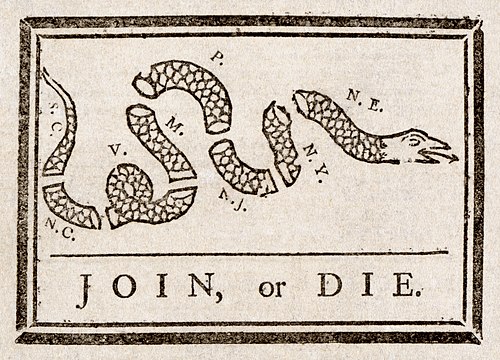
Join, or Die by Benjamin Franklin was recycled to encourage the former colonies to unite against British rule.

Minutemen during the Battles of Lexington and Concord, April 1775