Concussions in American football
Videos
Photos
Concussions and play-related head blows in American football have been shown to be the cause of chronic traumatic encephalopathy (CTE), which has led to player deaths and other debilitating symptoms after retirement, including memory loss, depression, anxiety, headaches, stress, and sleep disturbances.

1908 cartoon (by W.C. Morris) highlighting the dangers that were associated with the sport
American football
Videos
Photos
American football, also known as gridiron football, is a team sport played by two teams of eleven players on a rectangular field with goalposts at each end. The offense, the team with possession of the oval-shaped football, attempts to advance down the field by running with the ball or throwing it, while the defense, the team without possession of the ball, aims to stop the offense's advance and to take control of the ball for themselves. The offense must advance at least ten yards in four downs or plays; if they fail, they turn over the football to the defense, but if they succeed, they are given a new set of four downs to continue the drive. A game is won by the team with the higher number of points, which are scored primarily by advancing the ball into the opposing team's end zone for a touchdown or kicking the ball through the opponent's goalposts for a field goal.
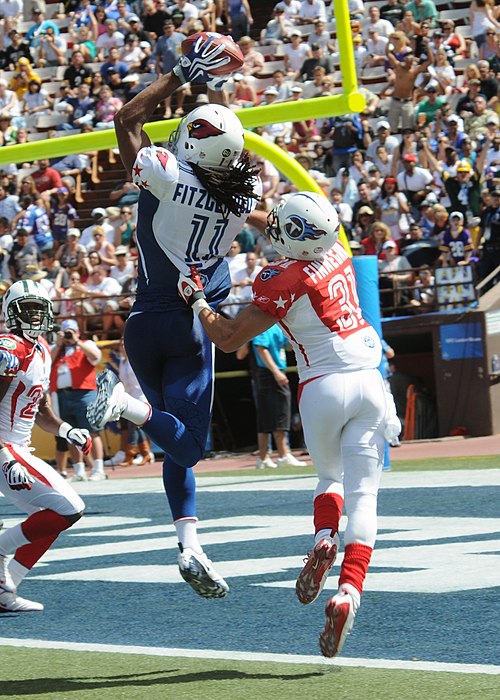
Larry Fitzgerald (in blue) catches a pass while Cortland Finnegan (in red) plays defense at the 2009 Pro Bowl.

Walter Camp, the "Father of American Football", in 1878 when Camp was captain of Yale University's football team
The dangers associated with the sport depicted in a 1908 cartoon by William Charles Morris

Pudge Heffelfinger, widely regarded as the first professional football player