Cordite
Videos
Cordite is a family of smokeless propellants developed and produced in Britain since 1889 to replace black powder as a military firearm propellant. Cordite is made by combining two chemical explosives

A sectioned British 18-pounder field gun shrapnel round, World War I, with bound string to simulate the appearance of the original cordite propellant

Close-up of cordite filaments in a .303 British rifle cartridge (manufactured in 1964)

Cordite production during World War II at a Royal Naval armaments factory at Holton Heath. The long strings of cordite are being combed to eliminate short lengths.

Bird's-eye view of a portion of Canadian Explosives Ltd., Nobel, Ontario
.303 British
Videos
The.303 British or 7.7×56mmR, is a.303-inch calibre rimmed tapered bottleneck centerfire rifle cartridge. The.303-inch bore diameter is measured between rifling lands as is the common practice in Euro
Cordite
…sufficient pressure to propel a bullet or shell to its target, but not so quickly as to damage the barrel of the gun. Cordite was used initially in the .303 British, Mark I and II, standard rifle cartridge between 1891 and 1915. Shortages of cordite in World War I led to the creation of the HM Factory, Gretna on…

Left to right: .303 British, 6.5×50mmSR Arisaka and .30-06 Springfield ballistic tip ammunition

.303 British maximum C.I.P. cartridge dimensions. All sizes in millimetres (mm).
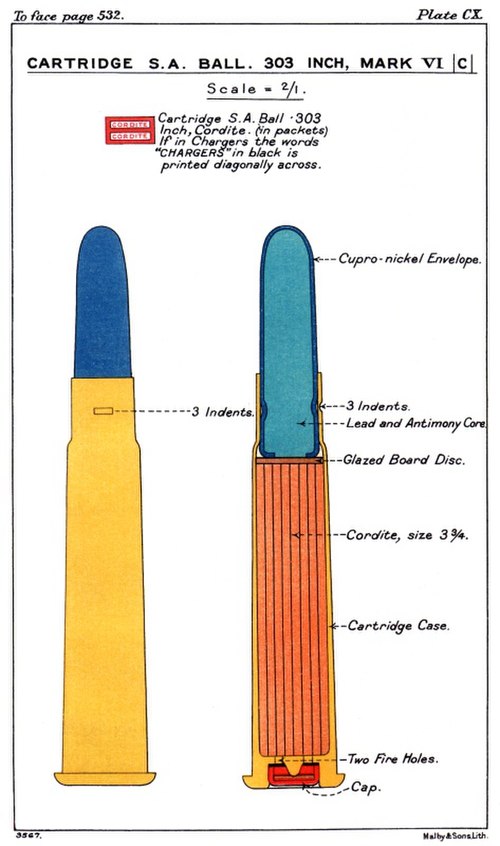
Longitudinal section of Mk VI ammunition 1904, showing the round nose bullet

Longitudinal section of Mk VII ammunition circa 1915, showing the "tail heavy" design