Corinthian helmet
Videos
The Corinthian helmet originated in ancient Greece and took its name from the city-state of Corinth. It was a helmet made of bronze which in its later styles covered the entire head and neck, with sli
Bronze Corinthian helmet, c. 500 BCE, Staatliche Antikensammlungen (Inv. 4330)

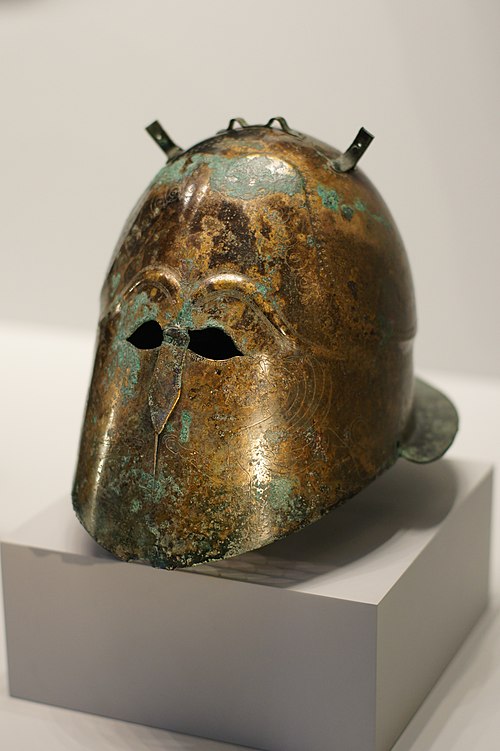
Italo-Corinthian helmet, Getty Villa

Bust of Pericles with Corinthian helmet, Roman copy after a Greek original from ca. 430 BC
Hoplite
Videos
Hoplites were citizen-soldiers of Ancient Greek city-states who were primarily armed with spears and shields. Hoplite soldiers used the phalanx formation to be effective in war with fewer soldiers. Th
Corinthian helmet
…covered the entire head and neck, with slits for the eyes and mouth. A large curved projection protected the nape of the neck. Out of combat, a Greek hoplite would wear the helmet tipped upward for comfort. This practice gave rise to a series of variant forms in Italy, where the slits were almost closed…

Hoplite, 5th century

Hoplites shown in two attack positions, with both an underhand and an overhand stance

Phalanx fighting on a black-figure amphora, c. 560 BC. The hoplite phalanx is a frequent subject in ancient Greek art.

Probable Spartan hoplite (Vix crater, c. 500 BC)