The Corrective Optics Space Telescope Axial Replacement (COSTAR) is an optical correction instrument designed and built by NASA. It was created to correct the spherical aberration of the Hubble Space Telescope's primary mirror, which incorrectly focused light upon the Faint Object Camera (FOC), Faint Object Spectrograph (FOS), and Goddard High Resolution Spectrograph (GHRS) instruments.

COSTAR being inserted into Hubble during First Servicing Mission.

Astronauts work on installing Hubble's corrective optics during Servicing Mission 1.

Closeup of the working mechanism from COSTAR. The mirrors extended out from the body of COSTAR on the left.
Hubble Space Telescope
Videos
The Hubble Space Telescope is a space telescope that was launched into low Earth orbit in 1990 and remains in operation. It was not the first space telescope, but it is one of the largest and most versatile, renowned as a vital research tool and as a public relations boon for astronomy. The Hubble telescope is named after astronomer Edwin Hubble and is one of NASA's Great Observatories. The Space Telescope Science Institute (STScI) selects Hubble's targets and processes the resulting data, while the Goddard Space Flight Center (GSFC) controls the spacecraft.

Seen in orbit from the departing Space Shuttle Atlantis in 2009, flying Servicing Mission 4 (STS-125), the fifth and final Hubble mission.
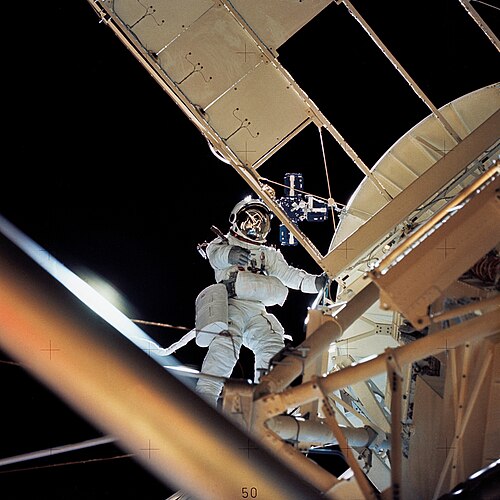
Astronaut Owen Garriott working next to Skylab's crewed solar space observatory, 1973

Lyman Spitzer played a major role in the birth of the Hubble Space Telescope project.
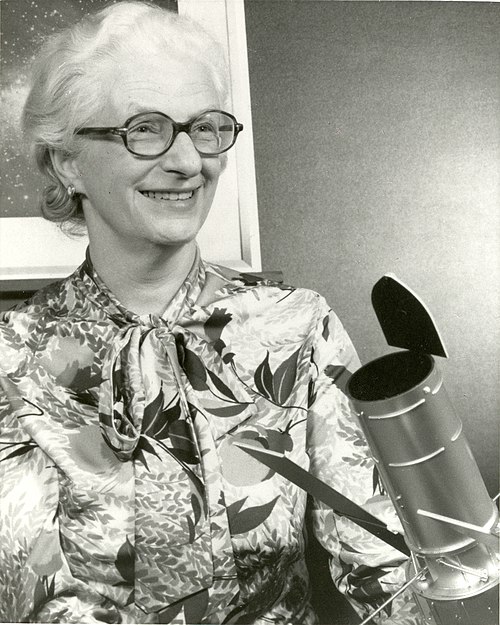
Nancy Grace Roman with a model of the Large Space Telescope that was eventually developed as the Hubble Space Telescope. While listed as a 1966 photo, this design was not the standard until the mid-1970s.