Cosmic Origins Spectrograph
Videos
The Cosmic Origins Spectrograph is a science instrument that was installed on the Hubble Space Telescope during Servicing Mission 4 in May 2009. It is designed for ultraviolet spectroscopy of faint po

The Cosmic Origins Spectrograph on its handling cart in the Spacecraft Systems Development Facility cleanroom at the Goddard Space Flight Center

COS Optical Layout. FUV and NUV channels initially share a common path. The first optic is either a concave, holographically ruled diffraction grating that directs light to the FUV detector (red) or a concave mirror directing light to the NUV gratings and the NUV detector (purple). The green colored ray packets represent the FUV optical paths, and blue colored ray packets represent the NUV optical paths. A wavelength reference and flat field delivery system is shown at top left (orange ray packets) and can provide simultaneous wavelength reference spectra during science observations.
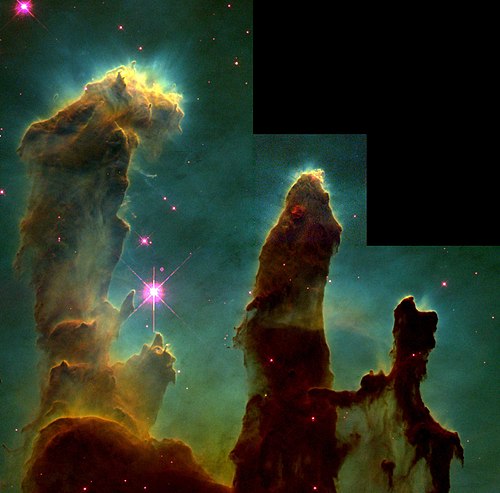
Eagle nebula pillars
Hubble Space Telescope
Videos
The Hubble Space Telescope is a space telescope that was launched into low Earth orbit in 1990 and remains in operation. It was not the first space telescope, but it is one of the largest and most ver
Cosmic Origins Spectrograph
…The Cosmic Origins Spectrograph (COS) is a science instrument that was installed on the Hubble Space Telescope during Servicing Mission 4 (STS-125) in May 2009. It is designed for ultraviolet (90–320 nm) spectroscopy of faint point sources with a resolving power…

The Hubble Space Telescope during STS-125

Lyman Spitzer played a major role in the birth of the Hubble Space Telescope project.
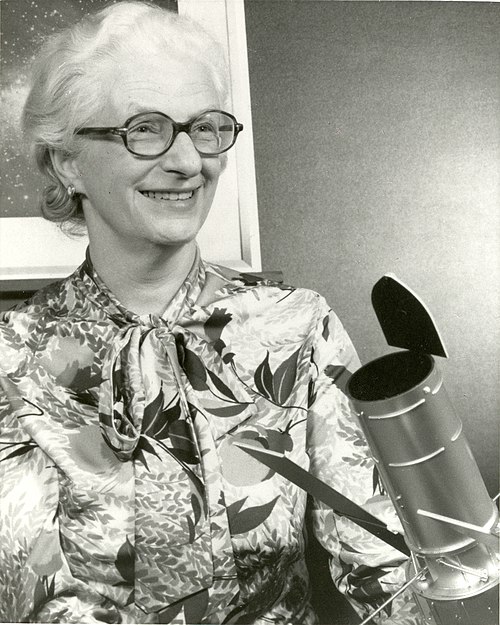
Nancy Grace Roman with a model of the Large Space Telescope that was eventually developed as the Hubble Space Telescope. While listed as a 1966 photo, this design was not the standard until the mid-1970s.

American astronomer Edwin P. Hubble (pictured in 1931), for whom the telescope is named.