Otto I, also called Otto the Great, is seen by many as one of the greatest medieval rulers. His name is usually associated with the foundation, the victory in the Battle of Lechfeld gained him, according to historian Jim Bradburn, a reputation as the great champion of Christendom, and the Ottonian Renaissance. Although historians in different eras have never denied his reputation as a successful ruler, the image of the nationalist political strongman which was usually perceived during the nineteenth century has been questioned by more recent sources. Modern historians explore the emperor's capability as a consensus builder, as well as the participation of princes in contemporary politics and the important roles played by female actors and his advisors in his endeavors. Mentioned also is that Otto did have a strong character. In many cases, Otto chose his own way, which also led to rebellions. He often emerged victorious in the end.

Battle of Lechtfeld (955) by Michael Echter, 1860.

Medieval rulers from Illustrierte Weltgeschichte für das Volk: Geschichte des Mittelalters (1882) by Otto von Corvin: Otto the Great as the central figure, Frederick Barbarossa (top center), Alfred the Great (upper left), King Saint Stephen (upper right), William the Conqueror (lower left), Hugh Capet (lower right), Charlemagne (lower center). Artist: Ludwig Burger (1825–1884).

Plaque with Christ receiving Magdeburg Cathedral from Emperor Otto I. Between 962 and 968. MET 41.100.157
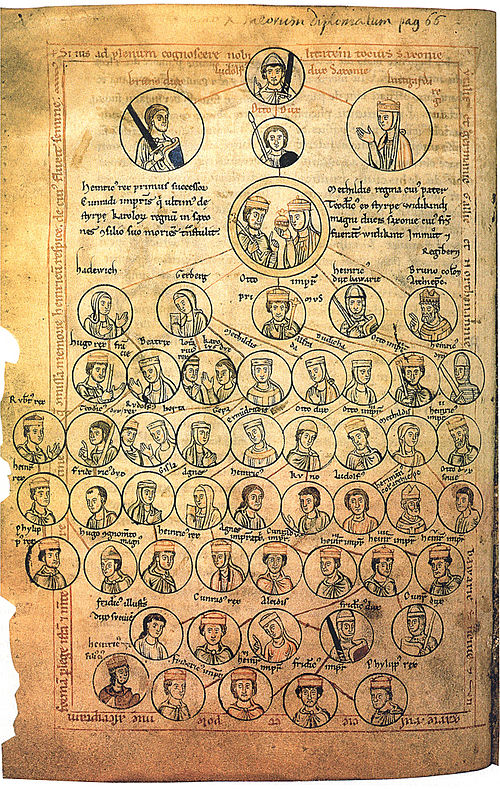
Genealogy of the Ottonians with Heinricus rex and Methildis regina in the double circle (Chronica St. Pantaleonis, 2nd half of 12th century. Herzog August Bibliothek, Wolfenbüttel, Cod. Guelf. 74.3 Aug., pag. 226)
Charles IV, Holy Roman Emperor, from the House of Luxembourg was King of Bohemia (1346–1378) and Holy Roman Emperor (1355–1378). A powerful and intellectual ruler, Charles has been remembered for his munificient patronage, especially in the Kingdom of Bohemia which reached the apex of political and cultural power under his reign. In the Holy Roman Empire, his Golden Bull of 1356 marked a point of change concerning the political structure of the Empire – some historians opine that this gave recognition to the victory of the particularism of the princes, while others think of the document as an achievement that maintained balance of power in the Empire and brought a measure of peace. Recently, some darker aspects of his rule like religious persecution have also attracted attention.

Charles IV's statue in Karolinum

The seal of the Golden Bull of 1356.

Charles IV and the dignitaries of Paris. Illustration from Grandes Chroniques de France, BnF, Ms fr. 6465, fol. 442v

Andrea di Bonaiuto. Santa Maria Novella. Charles IV is enthroned and sits next to the Pope (Urban V or Innocent VI) in the left foreground. Fresco (1366).