Culture of Iran
Videos
The culture of Iran or culture of Persia is one of the oldest and among the most influential in the world. Iran is widely regarded as one of the cradles of civilization. Because of its dominant geopol
Iran is filled with tombs of poets and musicians, such as this one belonging to Rahi Mo'ayeri. An illustration of Iran's deep artistic heritage.


Iranian chess (shatranj) set, glazed fritware, 12th century Nishapur. New York Metropolitan Museum of Art.

An ancient ice house, called a yakhchal, built in ancient times for storing ice during summers

Intricate stone art of Persepolis
Parthian Empire
Videos
The Parthian Empire, also known as the Arsacid Empire, was a major Iranian political and cultural power centered in ancient Iran from 247 BC to 224 AD. Its latter name comes from its founder, Arsaces
Culture of Iran
…and culture. In classical Iran, minstrels performed for their audiences at royal courts and in public theatres. A minstrel was referred to by the Parthians as gōsān, and by the Sasanians as huniyāgar. Since the Safavid Empire, storytellers and poetry readers appeared at coffeehouses. After the Iranian…

The silver drachma of Arsaces I (r. c. 247 – 211 BC) with the Greek language inscription ΑΡΣΑΚΟΥ "of Arsaces"
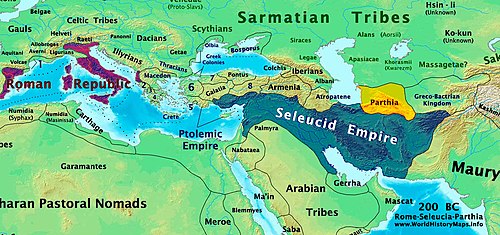
Parthia, shaded yellow, alongside the Seleucid Empire (blue) and the Roman Republic (purple) around 200 BC

Drachma of Mithridates I, showing him wearing a beard and a royal diadem on his head. Reverse side: Heracles/Verethragna, holding a club in his left hand and a cup in his right hand; Greek inscription reading ΒΑΣΙΛΕΩΣ ΜΕΓΑΛΟΥ ΑΡΣΑΚΟΥ ΦΙΛΕΛΛΗΝΟΣ "of the Great King Arsaces the Philhellene"

Statue of a Parthian woman, marble from Nisa; National Museum of History, Ashgabat, Turkmenistan