DVD player
Videos
A DVD player is a device that plays DVDs produced under both the DVD-Video and DVD-Audio technical standards, two different and incompatible standards. Some DVD players will also play audio CDs. DVD players are connected to a television to watch the DVD content, which could be a movie, a recorded TV show, or other content.

The interior of a DVD player

A portable DVD player

Output connectors of a DVD player (2016): The single HDMI connector on the left is employed to replace the older connection options for audio and video signals, which require at least two, depending on the use case even up to five, individual cable connections with RCA connectors (see middle section, colored). An exception was the technically outdated SCART type A/V connector most right.
Digital Visual Interface
Videos
Digital Visual Interface (DVI) is a video display interface developed by the Digital Display Working Group (DDWG). The digital interface is used to connect a video source, such as a video display controller, to a display device, such as a computer monitor. It was developed with the intention of creating an industry standard for the transfer of uncompressed digital video content.

A male DVI-D (single link) connector

DVI port on a Sony HD CRT TV that complies with EIA-861
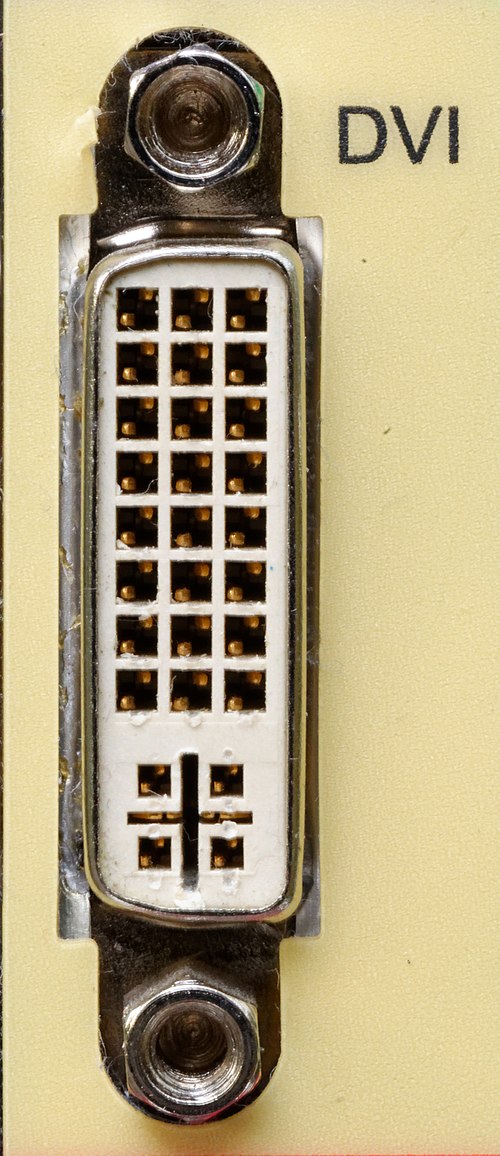
DVI output connector on a computer

A passive DVI-to-VGA adapter. This adapter will not work with a DVI-D output. It requires a DVI-I or DVI-A output to get the analog signal to a VGA input (even if the adapter looks like a DVI-D). A more expensive active adapter (or converter) is required to connect DVI-D to VGA.