Dada
Videos
Dada or Dadaism was an international art movement that developed in the context of World War I, its aftermath, and the Futurist movement. First established in Zürich, Switzerland, it later quickly spr

Grand opening of the first Dada exhibition: International Dada Fair, Berlin, 5 June 1920. The central figure hanging from the ceiling is an effigy of a German officer with a pig's head. From left to right: Raoul Hausmann, Hannah Höch (sitting), Otto Burchard, Johannes Baader, Wieland Herzfelde, Margarete Herzfelde, Dr. Oz (Otto Schmalhausen), George Grosz and John Heartfield.

Cover of the first edition of the publication Dada, Tristan Tzara; Zürich, 1917

Francis Picabia: left, Le saint des saints c'est de moi qu'il s'agit dans ce portrait, 1 July 1915; center, Portrait d'une jeune fille americaine dans l'état de nudité, 5 July 1915; right, J'ai vu et c'est de toi qu'il s'agit, De Zayas! De Zayas! Je suis venu sur les rivages du Pont-Euxin, New York, 1915[clarification needed]
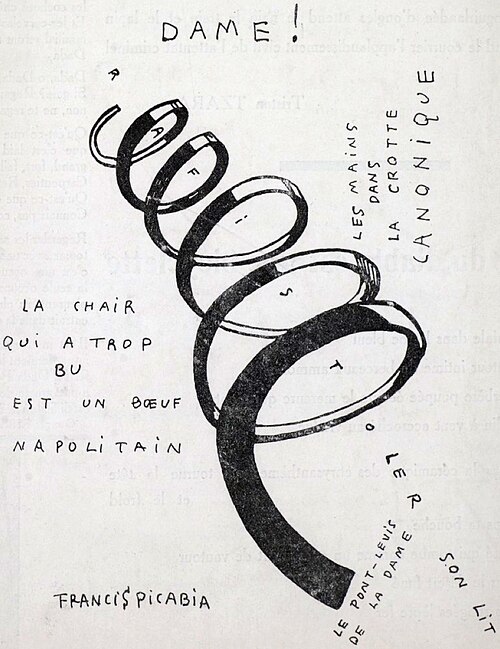
Francis Picabia, Dame! Illustration for the cover of the periodical Dadaphone, n. 7, Paris, March 1920
Hugo Ball
Videos
Hugo Ball was a German author, poet, dramatist, and journalist, and one of the principal founders of the Dada movement in European art in Zürich in 1916. Among other accomplishments, he was a pioneer
Dada
…movement focused on rejecting prevailing ideas surrounding art, and more broadly in society. The Dada movement's principles were first collected in Hugo Ball's Dada Manifesto in 1916. Ball is seen as the founder of the Dada movement. Other key figures in the movement included Emmy Hennings, Jean Arp, Johannes…

Ball in 1916

Ball performing sound poetry at the Cabaret Voltaire, 1916

Theo van Doesburg Dadamatinée