Damnatio ad bestias
Videos
Damnatio ad bestias was a form of Roman capital punishment where the condemned person was killed by wild animals, usually lions or other big cats. This form of execution, which first appeared during t

Leopard attacking a criminal, Roman floor mosaic, late 2nd century AD, Archaeological Museum of Tunisia
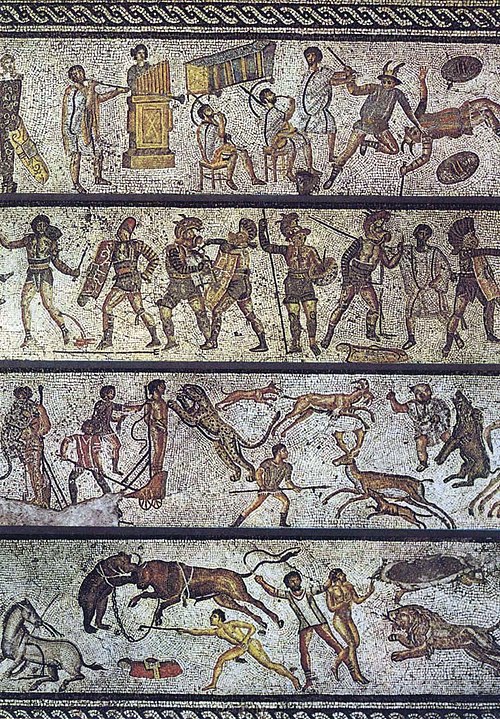
Gladiators in the circus arena, Zliten mosaic, 1st century AD

Gladiators fighting a barbary lion
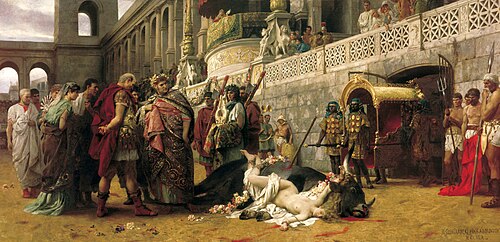
Christian Dirce by Henryk Siemiradzki (National Museum, Warsaw) shows the punishment of a Roman woman who had converted to Christianity. At the Emperor Nero's wish, the woman, like mythological Dirce, was tied to a wild bull and dragged around the arena.
Homosexuality in ancient Rome is a subject of research and scholarly debate. Conceptions of homosexuality in ancient Rome differed from the contemporary West. Latin lacks words that would precisely tr
Statue of Antinous (Delphi), polychrome Parian marble depicting Antinous, made during the reign of Hadrian (r. 117–138 AD), his lover


A drawing based on a fragment of an ancient Roman glass vessel. 1826 - 1827 British Museum, London

A fragment of a glass vessel showing a homosexual scene. Cameo. Around 15 BCE - 1st Century CE. British Museum, London

Heroic portrayal of Nisus and Euryalus (1827) by Jean-Baptiste Roman: Vergil described their love as pius in keeping with Roman morality