Death of Cleopatra
Videos
Cleopatra VII, the last ruler of Ptolemaic Egypt, died on either 10 or 12 August, 30 BC, in Alexandria, when she was 39 years old. According to popular belief, Cleopatra killed herself by allowing an asp to bite her, but according to the Roman-era writers Strabo, Plutarch, and Cassius Dio, Cleopatra poisoned herself using either a toxic ointment or by introducing the poison with a sharp implement such as a hairpin. Modern scholars debate the validity of ancient reports involving snakebites as the cause of death and whether she was murdered. Some academics hypothesize that her Roman political rival Octavian forced her to kill herself in a manner of her choosing. The location of Cleopatra's tomb is unknown. It was recorded that Octavian allowed for her and her husband, the Roman politician and general Mark Antony, who stabbed himself with a sword, to be buried together properly.

Roman painting from the House of Giuseppe II, Pompeii, early 1st century AD, most likely depicting Cleopatra VII, wearing her royal diadem, consuming poison in an act of suicide, while her son Caesarion, also wearing a royal diadem, stands behind her

Cleopatra and Mark Antony on the obverse and reverse, respectively, of a silver tetradrachm struck at the Antioch mint in 36 BC

Cleopatra and Octavian, a painting by Louis Gauffier, 1787

A hemiobol coin of Cleopatra VII struck in 31 BC (the year she and Mark Antony lost the Battle of Actium), showing her wearing the royal diadem
Julius Caesar was assassinated by a group of senators on the Ides of March of 44 BC during a meeting of the Senate at the Curia of Pompey of the Theatre of Pompey in Rome where the senators stabbed Caesar 23 times. They claimed to be acting over fears that Caesar's unprecedented concentration of power during his dictatorship was undermining the Roman Republic. At least 60 to 70 senators were party to the conspiracy, led by Marcus Junius Brutus, Gaius Cassius Longinus, and Decimus Junius Brutus Albinus. Despite the death of Caesar, the conspirators were unable to restore the institutions of the Republic. The ramifications of the assassination led to his martyrdom, the Liberators' civil war and ultimately to the Principate period of the Roman Empire.

The Death of Julius Caesar by Vincenzo Camuccini, c. 1805
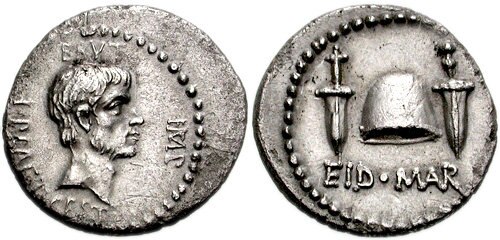
The Ides of March coin, a Denarius portraying Brutus (obverse), minted in 43–42 BC. The reverse shows a pileus between two daggers, with the legend EID MAR (Eidibus Martiis – on the Ides of March), commemorating the assassination.

Possible bust of Julius Caesar, posthumous portrait in marble, 44–30 BC, Museo Pio-Clementino, Vatican Museums

The city of Rome, 44 BC