Debris disk
Videos
A debris disk, or debris disc, is a circumstellar disk of dust and debris in orbit around a star. Sometimes these disks contain prominent rings, as seen in the image of Fomalhaut on the right. Debris

Hubble Space Telescope observation of the debris ring around Fomalhaut. The inner edge of the disk may have been shaped by the orbit of Fomalhaut b, at lower right.

VLT and Hubble images of the disc around AU Microscopii.
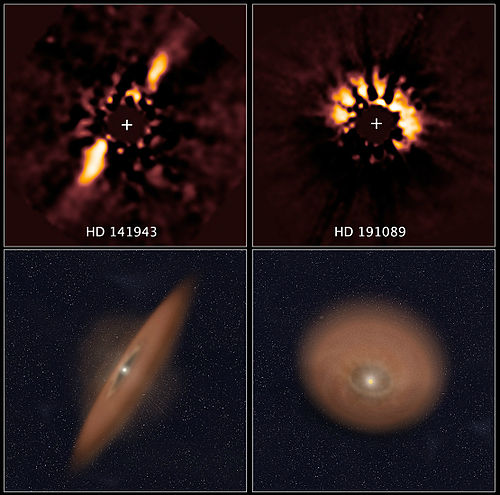
Debris disks detected in HST archival images of young stars, HD 141943 and HD 191089, using improved imaging processes (24 April 2014).
Beta Pictoris
Videos
Beta Pictoris is the second brightest star in the constellation Pictor. It is located 63.4 light-years from the Solar System, and is 1.79 times as massive and 8.7 times as luminous as the Sun. The Bet

Artist's impression of the planet Beta Pictoris b

Artist's impression of Beta Pictoris

Hubble Space Telescope image of the main and secondary debris disks

Artist's impression of planet formation processes occurring in the disc around Beta Pictoris