Dejima
Videos
Dejima or Deshima, in the 17th century also called Tsukishima, was an artificial island off Nagasaki, Japan, that served as a trading post for the Portuguese and subsequently the Dutch. For 220 years,
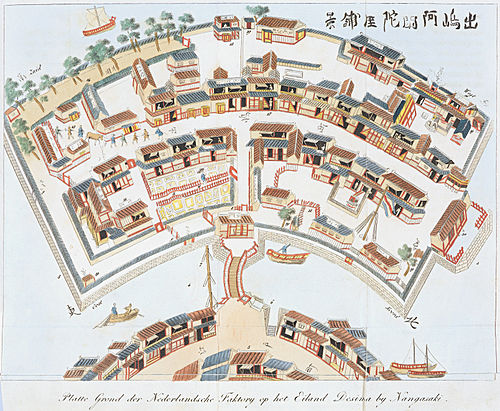
An imagined bird's-eye view of Dejima's layout and structures (copied from a woodblock print by Toshimaya Bunjiemon of 1780 and published in Isaac Titsingh's Bijzonderheden over Japan (1824/25)

A Dutchman with his servant at Dejima (18th-century painting by unknown artist, British Museum collection)

A 2017 model of Dejima in the Museum Volkenkunde in Leiden, Netherlands

A central part of reconstructed Dejima, Nagasaki, 2007
Shimabara Rebellion
Videos
The Shimabara Rebellion, also known as the Shimabara-Amakusa Rebellion or Shimabara-Amakusa Ikki, was an uprising that occurred in the Shimabara Domain of the Tokugawa shogunate in Japan from 17 Decem
Dejima
…leaving. Dejima housed European merchants and separated them from Japanese society while still facilitating lucrative trade with the West. Following a rebellion by mostly Catholic converts, the Portuguese were expelled in 1639. The Dutch were moved to Dejima in 1641, under stricter control and scrutiny, and segregated from Japanese society…

Buddhist statues of Jizō, the boddhisatva of mercy, beheaded.

Dutch ships at the siege (detail).

Shimabara Rebellion Battle Folding Screen by Saito Shuho

The ruins of Hara Castle on the Shimabara Peninsula.