Deutsches Eck
Videos
The Deutsches Eck is the name of a promontory in Koblenz, Germany, where the Mosel river joins the Rhine. Named after a local commandry of the Teutonic Order, it became known for a monumental equestrian statue of William I, first German Emperor, erected in 1897 in appreciation of his role in the unification of Germany. One of many Emperor William monuments raised in the Prussian Rhine Province, it was destroyed in World War II and only the plinth was preserved as a memorial. Following German reunification, a replica of the statue was erected on the pedestal after controversial discussions in 1993. It is today a Koblenz landmark and a popular tourist attraction.
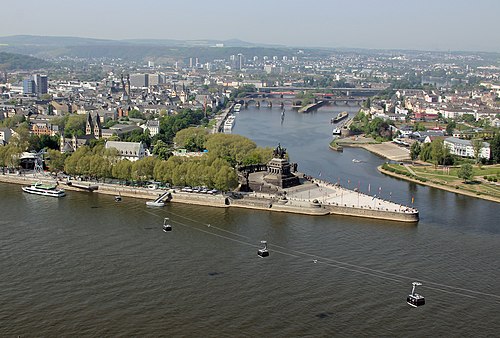
View of the Deutsches Eck from Ehrenbreitstein, showing the Koblenz Cableway

Aerial view of the confluence

Inauguration ceremony, 31 August 1897

The statue in ruins, 1945
Bruno Schmitz
Videos
Bruno Schmitz was a German architect best known for his monuments in the early 20th century. He worked closely with sculptors such as Emil Hundrieser, Nikolaus Geiger and Franz Metzner for integrated architectural and sculptural effect.

Völkerschlachtdenkmal (Monument to the Battle of the Nations) (1898–1913), Leipzig.

Poster "Ibach-Pianos", 1898 by Bruno Schmitz

The Symbol of Indiana. Schmitz's 1888 rendering for the Soldiers' and Sailors' Monument in Indianapolis, Indiana.

Kyffhäuser Monument (1889–96), Porta Westfalica.