Dew point
Videos
The dew point of a given body of air is the temperature to which it must be cooled to become saturated with water vapor. This temperature depends on the pressure and water content of the air. When the air is cooled below the dew point, its moisture capacity is reduced and airborne water vapor will condense to form liquid water known as dew. When this occurs through the air's contact with a colder surface, dew will form on that surface.

This graph shows the maximum percentage, by mass, of water vapor that air at sea-level pressure across a range of temperatures can contain. For a lower ambient pressure, a curve has to be drawn above the current curve. A higher ambient pressure yields a curve under the current curve.
Humidity
Videos
Humidity is the concentration of water vapor present in the air. Water vapor, the gaseous state of water, is generally invisible to the human eye. Humidity indicates the likelihood for precipitation, dew, or fog to be present.

Paranal Observatory on Cerro Paranal in the Atacama Desert is one of the driest places on Earth.
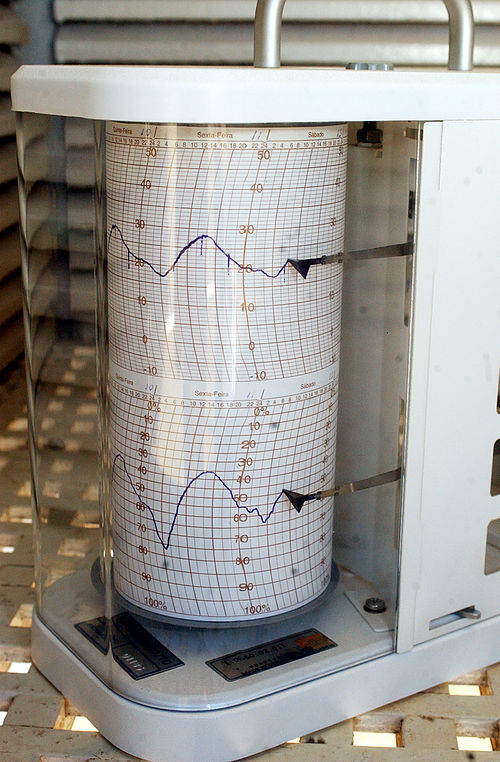
A hygrothermograph for humidity and temperature recording

Hygrometer for domestic use, wet/dry psychrometer type

Thermo hygrometer displaying temperature and relative humidity