Directional sound
Videos
Directional sound refers to the notion of using various devices to create fields of sound which spread less than most traditional loudspeakers. Several techniques are available to accomplish this, and
Line array of speakers

Loudspeaker
Videos
A loudspeaker is a combination of one or more speaker drivers, an enclosure, and electrical connections. The speaker driver is an electroacoustic transducer that converts an electrical audio signal in
Directional sound
…is naturally more directional because of its large size, a source with equivalent directivity can be made by utilizing an array of traditional small loudspeakers, all driven together in-phase. Acoustically equal to a large speaker, this creates a larger source size compared to wavelength, and the resulting sound…

Kellogg and Rice in 1925 holding the large driver of the first moving-coil cone loudspeaker

Prototype moving-coil cone loudspeaker by Kellogg and Rice in 1925, with electromagnet pulled back, showing voice coil attached to cone
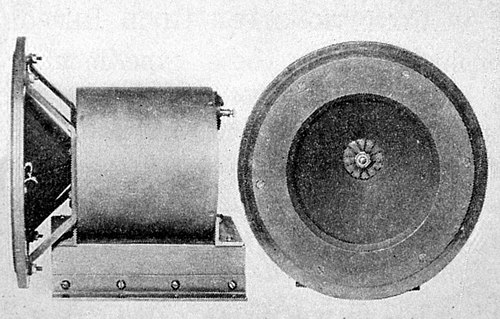
The first commercial version of the speaker, sold with the RCA Radiola receiver, had only a six-inch cone. In 1926 it sold for $250, equivalent to about $3000 today.

A four-way, high fidelity loudspeaker system. Each of the four drivers outputs a different frequency range; the fifth aperture at the bottom is a bass reflex port.