Disk wind
Videos
In astronomy, a disk wind is a particle outflow observed around accretion disks, mainly near protoplanetary disks and active galactic nuclei. The disk wind is made up of a gaseous and a dusty componen

Sketch (side-view) of the disk, protostar, protoplanet and disk wind around T Chamaeleontis, which was resolved with the James Webb Space Telescope by Bajaj et al.

Tau 042021 with its components in different colors. The collimated jets are red, the disk wind is green and the disk is blue and the dark aborption band. The disk wind was discovered in two papers.

Artist's impression of the disk wind around the stellar mass black hole IGR J17091-3624
Protoplanetary disk
Videos
A protoplanetary disk is a rotating circumstellar disc of dense gas and dust surrounding a young newly formed star, a T Tauri star, or Herbig Ae/Be star. The protoplanetary disk may not be considered
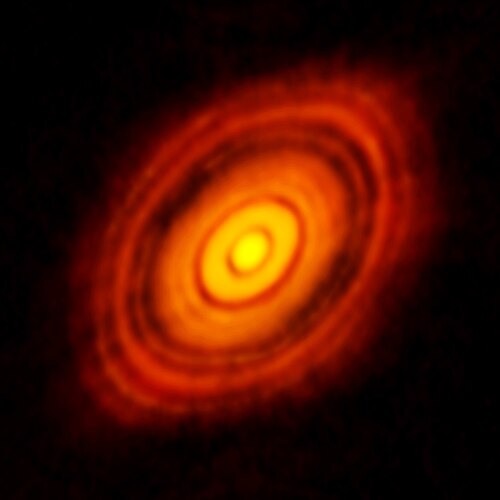
Atacama Large Millimeter Array image of HL Tauri

A 2009 image showing fractions of stars that suggest some evidence of having a protoplanetary disk as a function of their stellar age in millions of years; The samples are nearby young clusters and associations.

Protoplanetary disk. Simulated spiral arm vs observational data.

An artist's illustration giving a simple overview of the main regions of a protoplanetary disk, delineated by the soot and frost line, which for example has been observed around the star V883 Orionis.