The Dormition of the Mother of God is a Great Feast of the Eastern Orthodox, Oriental Orthodox, and Eastern Catholic Churches. It celebrates the "falling asleep" of Mary the Theotokos, and her being t
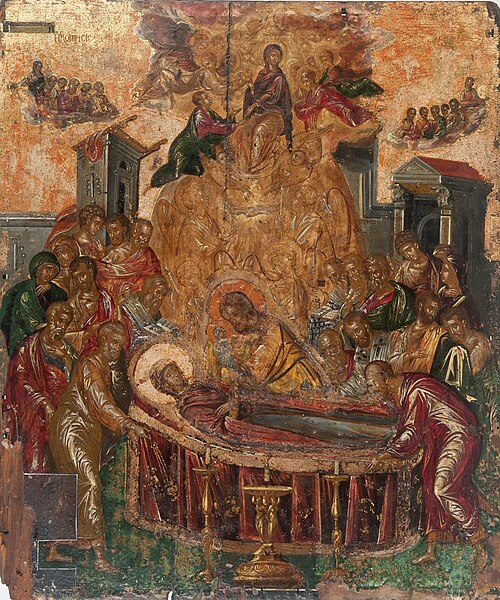
Icon of the Dormition by El Greco, 16th century (Cathedral of the Dormition, Ermoupolis)

The Dormition and Assumption of the Virgin by Elias Moskos circa 1679

The Dormition and Assumption of the Virgin by Fra Angelico circa 1434

Icon of the Dormition by Theophan the Greek, 1392. The Theotokos is depicted lying on a bier, surrounded by the Twelve Apostles. At center, Jesus Christ is shown in a mandorla, swaddling the soul of the Virgin Mary (a red seraph is shown above his head). To either side of him are depicted the Hieromartyrs Dionysius the Areopagite and Ignatius the God-Bearer who, according to tradition, are responsible for transmitting the account of the dormition.
In the Eastern Orthodox Church, the feast of the death and Resurrection of Jesus, called Pascha, is the greatest of all holy days and as such it is called the "feast of feasts". Immediately below it i
Dormition of the Mother of God
…The Dormition of the Mother of God is a Great Feast of the Eastern Orthodox, Oriental Orthodox, and Eastern Catholic Churches (except the East Syriac churches). It celebrates the "falling asleep" (death…

Wing from a Byzantine micromosaic diptych of the 12 Great Feasts, c. 1310. From top left: Annunciation, Nativity, Presentation, Baptism, Transfiguration, Raising of Lazarus.

Wing from a Byzantine micromosaic diptych of the 12 Great Feasts, c. 1310. From top left: Entry into Jerusalem, Crucifixion of Jesus, Harrowing of Hell, Ascension of Christ, Pentecost, Dormition of the Theotokos.

Christ Pantocrator mosaic from Hagia Sophia 2744 x 2900 pixels 3.1 MB