On 11 March 1942, during World War II, General Douglas MacArthur and members of his family and staff left the Philippine island of Corregidor and his forces, which were surrounded by the Japanese. They traveled in PT boats through stormy seas patrolled by Japanese warships and reached Mindanao two days later. From there, MacArthur and his party flew to Australia in a pair of Boeing B-17 Flying Fortresses, ultimately arriving in Melbourne by train on 21 March. In Australia, he declared, "I came through and I shall return".

PT-32, one of the four PT-20 class motor torpedo boats involved in the first part of the journey

MacArthur, as the focus of U.S. war propaganda, became a symbol of Allied resistance to the Japanese

The Chief of Staff of the United States Army, George C. Marshall (left) confers with the Secretary of War, Henry L. Stimson, in January 1942
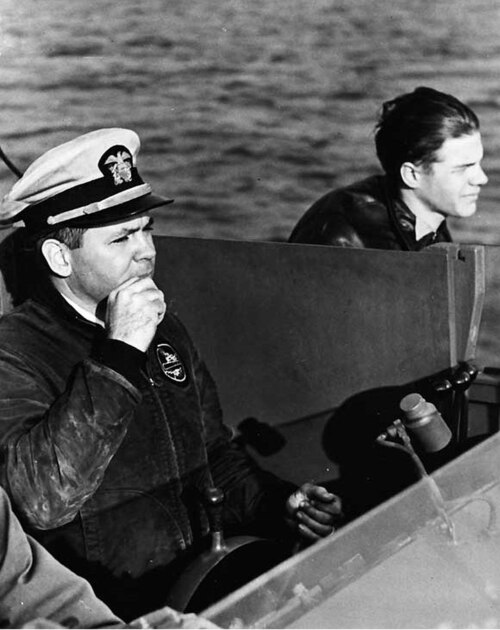
Lieutenant John D. Bulkeley (left) at the helm of a PT boat
John D. Bulkeley
Videos
John Duncan Bulkeley was a vice admiral in the United States Navy and was one of its most decorated naval officers. Bulkeley received the Medal of Honor for actions in the Pacific Theater during World War II. He was also the PT boat skipper who evacuated General Douglas MacArthur from Corregidor in the Philippines and commanded at the Battle of La Ciotat.


Bulkeley as a lieutenant in the Navy

WWII poster with quote from John D. Bulkeley

Lieutenant Commander Bulkeley being awarded the Medal of Honor by President Franklin D. Roosevelt