Drachenfels (Siebengebirge)
Videos
The Drachenfels is a hill in the Siebengebirge uplands between Königswinter and Bad Honnef in Germany. The hill was formed by rising magma that could not break through to the surface, and then cooled
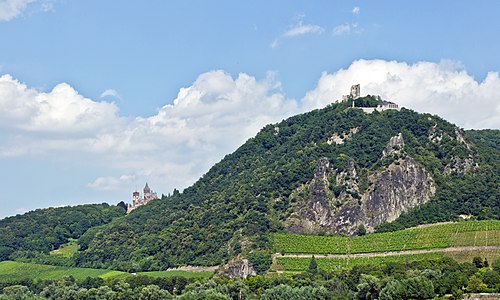
Drachenfels, view from Mehlem

Drachenfels – aerial view

The Drachenfels in 1624 by Matthäus Merian. The slide used to transport the rock from the quarry to the Rhine is shown, as is the (now disappeared) Burg Wolkenburg and an intact Burgfried. The engraving is an advertisement for glass windows.

Königswinter and the Drachenfels. Postcard in Photochrom, around 1900
Königswinter
Videos
Königswinter is a town and summer resort in the Rhein-Sieg district, in North Rhine-Westphalia, Germany.
Drachenfels (Siebengebirge)
…The Drachenfels ("Dragon's Rock", German pronunciation: ) is a hill (321 metres (1,053 ft)) in the Siebengebirge uplands between Königswinter and Bad Honnef in Germany. The hill was formed by rising magma that could not break through to the surface, and then cooled and became solid underneath…

Front of St. Remigius Roman Catholic Church (May 2009)

Bonn tram 7577 at Königswinter

Lithography of St. Remigius (August Karstein, 1850)

Homes in Königswinter