Dragons in Greek mythology
Videos
Dragons play a significant role in Greek mythology. Though the Greek drakōn often differs from the modern Western conception of a dragon, it is both the etymological origin of the modern term and by e
Depiction of the Ismenian dragon from a red-figured calix-krater found in Sant'Agata de' Goti (Campania), ca. 350–340 BC


Zeus aiming his thunderbolt at a winged and snake-footed Typhon. Chalcidian black-figured hydria (c. 540–530 BC), Staatliche Antikensammlungen (Inv. 596).

Mosaic of the third century BC from Kaulon (Magna Graecia, southern Italy)

The Dragon protecting the fleece swallows Jason as Athena comes to the rescue. Attic red-figure kylix, c. 480-470 BC
Echidna (mythology)
Videos
In Greek mythology, Echidna was a monster, half-woman and half-snake, who lived alone in a cave. She was the mate of the fearsome monster Typhon and was the mother of many of the most famous monsters
Dragons in Greek mythology
…mythology, the last son of Gaia. He is usually envisioned as humanoid from the waist up, serpentine below, almost the size of a mountain. With his mate Echidna, he would father many monsters. Later, he would attempt to overthrow Zeus for the title of ruler of the cosmos. Zeus would hurl an enormous rock on him…

Echidna. Sculpture by Pirro Ligorio 1555, Parco dei Mostri (Monster Park), Lazio, Italy

Orthrus
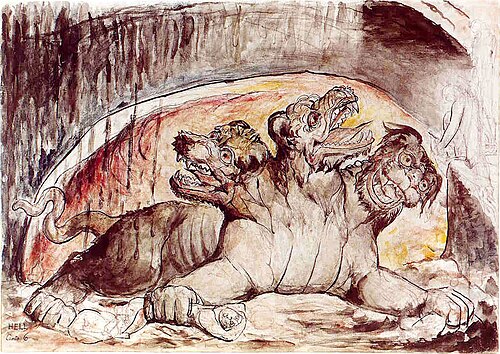
Cerberus, with the gluttons in Dante's Third circle of hell. William Blake.