Dura-Europos
Videos
Dura-Europos was a Hellenistic, Parthian, and Roman border city built on an escarpment 90 metres above the southwestern bank of the Euphrates river. It is located near the village of Salhiyé, in present-day Syria. Dura-Europos was founded around 300 BC by Seleucus I Nicator, who founded the Seleucid Empire as one of the Diadochi of Alexander the Great. In 113 BC, Parthians conquered the city, and held it, with one brief Roman intermission, until 165 AD. Under Parthian rule, it became an important provincial administrative centre. The Romans decisively captured Dura-Europos in 165 AD and greatly enlarged it as their easternmost stronghold in Mesopotamia, until it was captured by the Sasanian Empire after a siege in 256–257 AD. Its population was deported, and the abandoned city eventually became covered by sand and mud and disappeared from sight.

Temple of Bel, Dura-Europos

A view of the southern wadi and part of the walls of the city of Dura-Europos.

The Palmyrene Gate, the principal entrance to the city of Dura-Europos.

The tile from the ceiling of a House of Scribes that bears a Greek inscription that identifies the man by name, Heliodoros, and occupation, actuarius. The style and technique of the figure—the frontal pose, large eyes, subtle shading, and earth-toned pigments—recall other painted decoration in the city's buildings.
Tunnel warfare
Videos
Tunnel warfare is using tunnels and other underground cavities in war. It often includes the construction of underground facilities in order to attack or defend, and the use of existing natural caves and artificial underground facilities for military purposes. Tunnels can be used to undermine fortifications and slip into enemy territory for a surprise attack, while it can strengthen a defense by creating the possibility of ambush, counterattack and the ability to transfer troops from one portion of the battleground to another unseen and protected. Also, tunnels can serve as shelter from enemy attack.

Diorama of defensive tunnels dug during the Second Sino-Japanese War

Explosion of the mine beneath Hawthorn Ridge Redoubt on the Western Front during World War I (July 1, 1916). Photo by Ernest Brooks
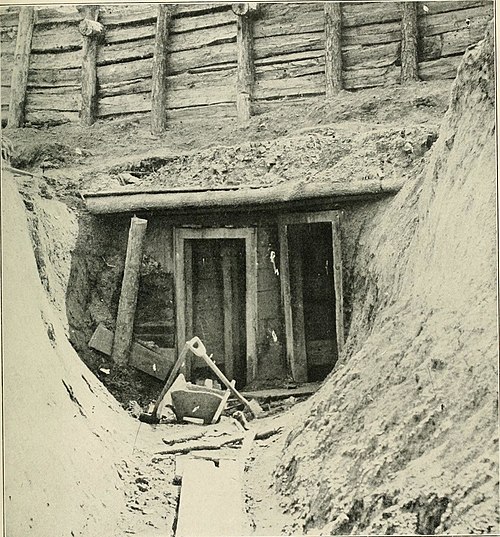
A Confederate counter mine burrow at Fort Mahone, Petersburg, Virginia

Example of a mine gallery with timber roof support