ENIAC
Videos
ENIAC was the first programmable, electronic, general-purpose digital computer, completed in 1945. Other computers had some of these features, but ENIAC was the first to have them all. ENIAC was Turin

Four ENIAC panels and one of its three function tables at the School of Engineering and Applied Science at the University of Pennsylvania

Glenn A. Beck (background) and Betty Snyder (foreground) program ENIAC in BRL building 328. (U.S. Army photo, c. 1947–1955)
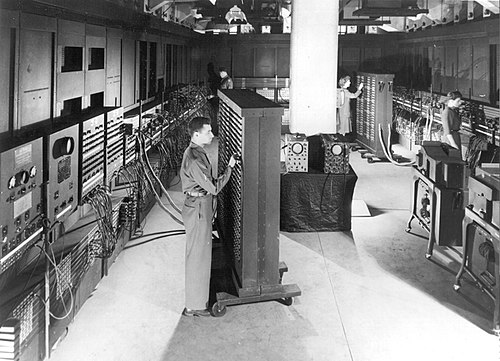
Cpl. Irwin Goldstein (foreground) sets the switches on one of ENIAC's function tables at the Moore School of Electrical Engineering. (U.S. Army photo, 1946)

Programmers Betty Jean Jennings (left) and Fran Bilas (right) operating ENIAC's main control panel at the Moore School of Electrical Engineering, c. 1945 (U.S. Army photo from the archives of the ARL Technical Library)
John von Neumann
Videos
John von Neumann was a Hungarian and American mathematician, physicist, computer scientist and engineer. Von Neumann had perhaps the widest coverage of any mathematician of his time, integrating pure
ENIAC
…describe programs for the ENIAC, including: Although the Ballistic Research Laboratory was the sponsor of ENIAC, one year into this three-year project John von Neumann, a mathematician working on the hydrogen bomb at Los Alamos National Laboratory, became aware of the ENIAC. In December 1945, the ENIAC was used to…

Excerpt from the university calendars for 1928 and 1928/29 of the Friedrich-Wilhelms-Universität Berlin announcing Neumann's lectures on the theory of functions II, axiomatic set theory and mathematical logic, the mathematical colloquium, review of recent work in quantum mechanics, special functions of mathematical physics and Hilbert's proof theory. He also lectured on the theory of relativity, set theory, integral equations and analysis of infinitely many variables.

Von Neumann's gravestone

Von Neumann's memorial plaque on the wall of his birthplace in Budapest, 5th district Báthory u. 26.

The AVIDAC computer was partially based on the architecture of the IAS machine developed by von Neumann.