Early Caliphate navy
Videos
The Arab Empire maintained and expanded a wide trade network across parts of Asia, Africa and Europe. This helped establish the Arab Empire as the world's leading economic power throughout the 8th–13t

Boat from Magan, an ancient Oman civilization dated 2300 BC

Marine activity of Muslims in the eastern basin of the Mediterranean circa sixth to seventh century AD. Blue lines for the activity during Rashidun caliphate, while green lines indicates the activity started from Mu'awiya caliphate

Pizani harbour, Acre, the departure place of the Mu'awiya fleet heading to invade Cyprus in the year 28 AH .

Two humped Bactrian camels used by Muhammad ibn Qasim in Sindh campaign
Byzantine Empire
Videos
The Byzantine Empire, also known as the Eastern Roman Empire, was the continuation of the Roman Empire centred on Constantinople during late antiquity and the Middle Ages. Having survived the fall of
Early Caliphate navy
…The pacification of Rhodes was mounted by Junada ibn Abi Umayya al-Azdi who according to early Muslim sources, oversaw the naval raids against the Byzantine Empire during the governorship of Syria by Mu'awiyah. However, their activity were halted during the First Muslim Civil War (656–661). Some historians treated…

Constantine I, also known as Constantine the Great, was Roman emperor from AD 306 to 337 and the first Roman emperor to convert to Christianity. He founded the city of Constantinople (now Istanbul) and made it the capital of the Empire, which it remained for over a millennium.

The Theodosian Walls of Constantinople, very important during the 717–718 siege
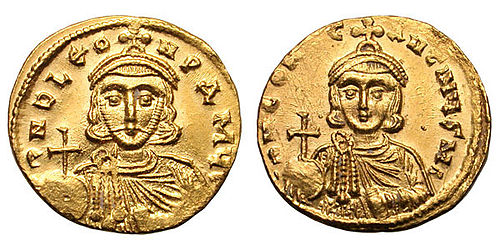
Gold solidus of Leo III (left) and his son and heir, Constantine V (right)

The seizure of Edessa (1031) by the Byzantines under George Maniakes and the counterattack by the Seljuk Turks