Early Modern Irish
Videos
Early Modern Irish was a transitional language between Middle Irish and Modern Irish. Its literary form, Classical Gaelic, was used in Ireland and Scotland from the 13th to the 18th century.
fol. 170r of the Book of Ballymote (1390), the Auraicept na n-Éces explaining the Ogham script.


Multilingual phrasebook compiled for Elizabeth I of England.
Scottish Gaelic
Videos
Scottish Gaelic, also known as Scots Gaelic or simply Gaelic, is a Celtic language native to the Gaels of Scotland. As a member of the Goidelic branch of Celtic, Scottish Gaelic, alongside both Irish
Early Modern Irish
…literary form of Gaelic that was in use by poets in Scotland and Ireland from the 13th century to the 18th century. Although the first written signs of Scottish Gaelic having diverged from Irish appear as far back as the annotations, dated to the early 12th century, in the Book of Deer, Scottish Gaelic did not have a…
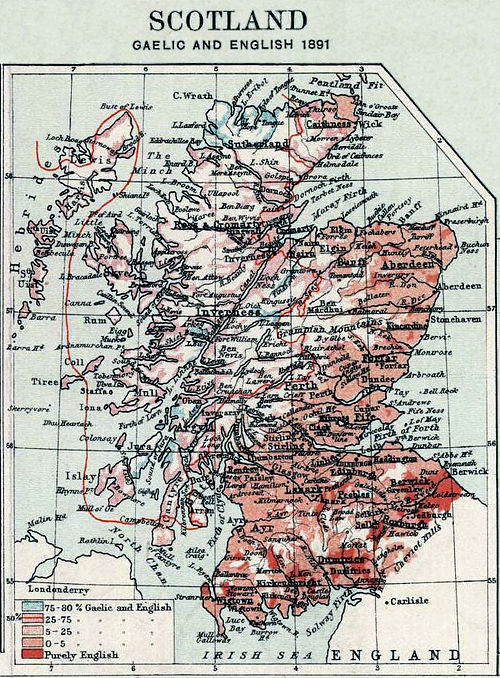
1891 distribution of English (including Scots) and Gaelic in Scotland 75–80% Gaelic, and English ━ 25–75% Gaelic, and English; line indicates the 50% isogloss 5–25% Gaelic, and English 0–5% Gaelic, and English Purely English

Bilingual signage on the Caledonian Macbrayne ferry terminal in Oban, the principal port serving the Hebrides

Royal Bank of Scotland sign in Portree

Cumbernauld Gaelic Choir in 2021