Early modern human
Videos
Early modern human, or anatomically modern human, are terms used to distinguish Homo sapiens that are anatomically consistent with the range of phenotypes seen in contemporary humans, from extinct arc
Reconstruction of early Homo sapiens from Jebel Irhoud, Morocco, c. 315,000 years BP

100 to 80 thousand year old Skhul V from Israel

Layer sequence at Ksar Akil in the Levantine corridor, and discovery of two fossils of Homo sapiens, dated to 40,800 to 39,200 years BP for "Egbert", and 42,400–41,700 BP for "Ethelruda".
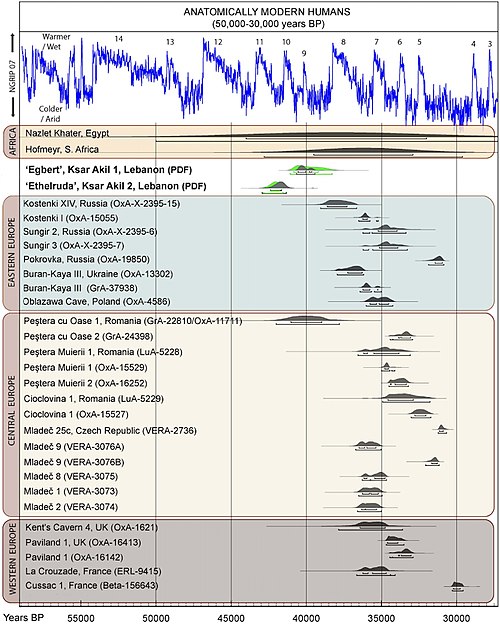
Known archaeological remains of anatomically modern humans in Europe and Africa, directly dated, calibrated carbon dates as of 2013.
Cro-Magnon
Videos
Cro-Magnons or European early modern humans were the first early modern humans found in Europe and Siberia, continuously occupying the continent possibly from as early as 56,800 years ago. They intera
Early modern human
…the Bab-el-Mandeb, and in the Great Coastal Migration spread to South Asia, Maritime South Asia and Oceania between 65,000 and 50,000 years ago, while Europe, East and North Asia were reached by about 45,000 years ago. Some evidence suggests that an early wave of humans may have reached the Americas by about…

Skull of Cro-Magnon 1

Bohunician scrapers in the Moravian Museum, Czech Republic

Abri de Cro-Magnon

1916 reconstruction of Cro-Magnon 1