Early modern period
Videos
The early modern period, c. 1500 – c. 1800, is a historical period, with divisions based primarily on the history of Europe and the broader concept of modernity. There is no exact date that marks the

A Japanese depiction of a Portuguese trading carrack. Advances in shipbuilding technology during the Late Middle Ages would pave the way for the global European presence characteristic of the early modern period.

Cishou Temple Pagoda, built in 1576: the Chinese believed that building pagodas on certain sites according to geomantic principles brought about auspicious events; merchant-funding for such projects was needed by the late Ming period.

Painting depicting the Qing Chinese celebrating a victory over the Kingdom of Tungning in Taiwan. This work was a collaboration between Chinese and European painters.

The Great Wave off Kanagawa, c. 1830 by Hokusai, an example of art flourishing in the Edo period
Middle Ages
Videos
In the history of Europe, the Middle Ages or medieval period lasted approximately from the 5th to late 15th centuries, comparable with the post-classical period of global history. The medieval period
Early modern period
…and is variably considered to have ended at the 18th or 19th century (1700–1800). In a European context, it is defined as the period following the Middle Ages and preceding the advent of modernity, but there is no universal agreement on the dates of these boundaries. In the context of global history, the early…

A medieval stained glass panel from Canterbury Cathedral, c. 1175 – c. 1180, depicting the Parable of the Sower, a biblical narrative
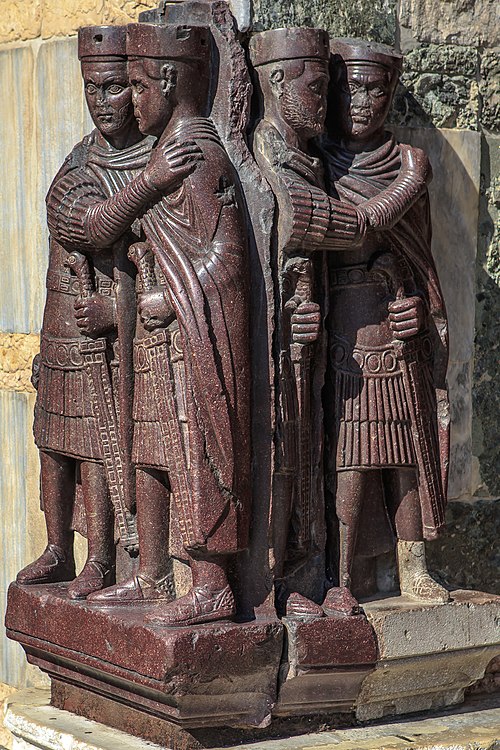
A late Roman sculpture depicting the four Tetrarchs, now in Venice, Italy

A coin of the Ostrogothic leader Theoderic the Great, struck in Milan, Italy, c. AD 491–501

A mosaic showing Justinian with the bishop of Ravenna (Italy), bodyguards, and courtiers.