Echmarcach mac Ragnaill
Videos
Echmarcach mac Ragnaill was a dominant figure in the eleventh-century Irish Sea region. At his height, he reigned as king over Dublin, the Isles, and perhaps the Rhinns of Galloway. The precise identi

Echmarcach's name as it appears on folio 17r of Oxford Bodleian Library Rawlinson B 488 (the Annals of Tigernach): "Eachmarcach".
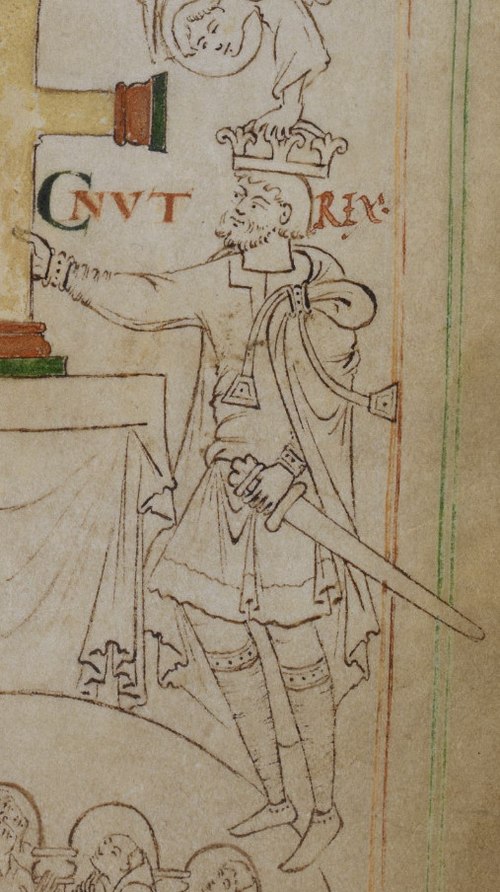
Depiction of Knútr as it appears on folio 6r of British Library Stowe 944.

Ruinous Cruggleton Castle from a distance. The fortress was likely a power centre of later Lords of Galloway, and could have been a seat of Echmarcach himself.

The name of Ælfgar Leofricson as it appears on folio 161v of British Library Cotton Tiberius B I (the "C" version of the Anglo-Saxon Chronicle): "Ælfgar eorl".
Cnut
Videos
Cnut, also known as Canute and with the epithet the Great, was King of England from 1016, King of Denmark from 1018, and King of Norway from 1028 until his death in 1035. The three kingdoms united und
Echmarcach mac Ragnaill
…member of the Uí Ímair kindred. Echmarcach first appears on record in about 1031, when he was one of three kings in northern Britain who submitted to Knútr Sveinnsson, ruler of the Anglo-Scandinavian Empire. Echmarcach is recorded to have ruled over Dublin in 1036–1038 and 1046–1052. After losing Dublin for the final…

Contemporary drawing of King Cnut from the New Minster Liber Vitae, 1031

This runestone in Sweden (U 194), in memory of a Viking known as Alli, says he won Knútr's payment in England.

Medieval illumination depicting Kings Edmund Ironside (left) and Cnut (right), from the Chronica Majora written and illustrated by Matthew Paris

Silver penny of Cnut the Great with a quatrefoil on the obverse dating to the period c.1017–23