Ecliptic
Videos
The ecliptic or ecliptic plane is the apparent path of the Sun on the celestial sphere, resulting from Earth's orbit around the Sun. It was a central concept in a number of ancient sciences, providing

A depiction of the early Solar System's protoplanetary disk from which Earth and other Solar System bodies were formed

A dark sky view, showing the difference in inclination of the galactic plane of the Milky Way to the not much inclined to each other orbital planes of the Solar System planets incl. the ecliptic, which is illuminated by the outlined zodiacal light and flanked by a meteor shower

The general motion and orientation of the Sun, with Earth and the Moon as its Solar System satellites

At Earth's poles the Sun appears at the horizon only and all day around equinox, marking the change between the half year long polar night and polar day. The picture shows the South Pole right before March equinox, with the Sun appearing through refraction despite being still below the horizon.
Solar eclipse
Videos
A solar eclipse occurs when the Moon passes between Earth and the Sun, thereby obscuring the view of the Sun from a small part of Earth, totally or partially. Such an alignment occurs approximately ev
Ecliptic
…ecliptic) results in the revolution of the lunar nodes relative to the Earth. This causes an eclipse season approximately every six months, in which a solar eclipse can occur at the new moon phase and a lunar eclipse can occur at the full moon phase. Because the orbit of the Moon is inclined only about 5.145° to…

A total solar eclipse occurs when the Moon completely covers the Sun's disk. Solar prominences can be seen along the limb (in red) as well as extensively the coronal and partly the radiating coronal streamers. (August 11, 1999)

An annular solar eclipse occurs when the Moon is too far away to completely cover the Sun's disk (October 14, 2023).
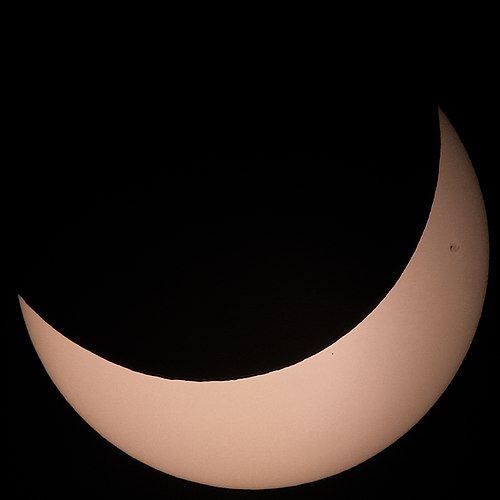
During a partial solar eclipse, the Moon blocks only part of the Sun's disk (October 25, 2022).
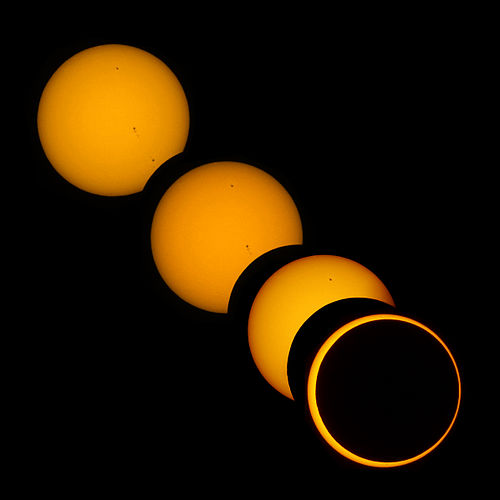
Partial and annular phases of the solar eclipse of May 20, 2012