Eddy (fluid dynamics)
Videos
In fluid dynamics, an eddy is the swirling of a fluid and the reverse current created when the fluid is in a turbulent flow regime. The moving fluid creates a space devoid of downstream-flowing fluid

Reynolds Experiment (1883). Osborne Reynolds standing beside his apparatus.
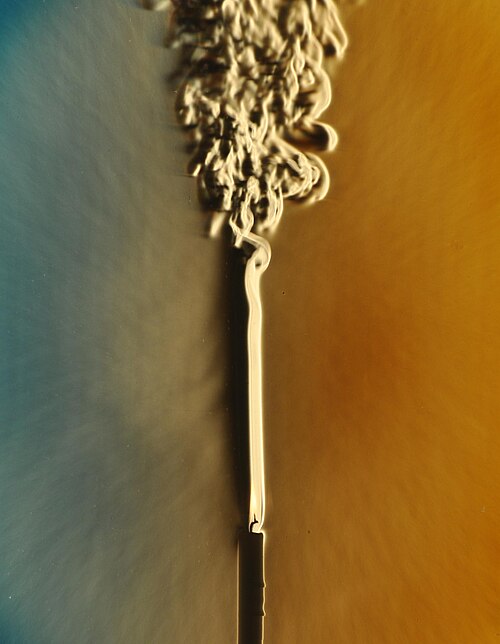
Schlieren photograph showing the thermal convection plume rising from an ordinary candle in still air. The plume is initially laminar, but transition to turbulence occurs in the upper third of the image. The image was made by Gary Settles using a one-meter-diameter schlieren mirror.

Downwind of obstacles, in this case, the Madeira and the Canary Islands off the west African coast, eddies create turbulent patterns called vortex streets.
Vortex
Videos
In fluid dynamics, a vortex is a region in a fluid in which the flow revolves around an axis line, which may be straight or curved. Vortices form in stirred fluids and may be observed in smoke rings,
Eddy (fluid dynamics)
…emergent rocks in swift-flowing rivers. An eddy is a movement of fluid that deviates from the general flow of the fluid. An example for an eddy is a vortex which produces such deviation. However, there are other types of eddies that are not simple vortices. For example, a Rossby wave is an eddy which is…

Vortex created by the passage of an aircraft wing, revealed by colored smoke

A Kármán vortex street is shown in this photo, as winds from the west blow onto clouds that have formed over the mountains in the desert. This phenomenon observed from ground level is extremely rare, as most cloud-related Kármán vortex street activity is viewed from space.

The Crow instability of a jet aeroplane's contrail visually demonstrates the vortex created in the atmosphere (gas fluid medium) by the passage of the aircraft.

Saturn's north polar vortex