Effects of Hurricane Floyd in Pennsylvania
The effects of Hurricane Floyd in Pennsylvania were concentrated in southeastern portions of the state, and included over a dozen deaths. Hurricane Floyd made landfall in North Carolina and, in a weakened state, impacted the Mid-Atlantic States with torrential rainfall. Over 10 in (250 mm) of rain in the state caused extensive and damaging flash flooding that affected over 10,000 homes. Many people became stranded due to the flood waters, and thousands had to be evacuated. Relatively strong winds resulted in widespread downed trees, some of which landed on houses and vehicles. Total preliminary damage from the storm was $60 million, and it is estimated that 13 people died due to the storm. Following the floods, multiple counties were declared major disaster areas.
Tropical Storm Floyd near landfall in southern New York
Effects of Hurricane Floyd in Florida
Hurricane Floyd in 1999 threatened Florida as a major hurricane roughly three times as large as Hurricane Andrew. Floyd originated from a tropical wave well east of the Lesser Antilles on September 7. While approaching the Bahamas, the storm strengthened significantly between September 12 and September 13. On the latter day, Floyd peaked as a strong Category 4 hurricane on the Saffir–Simpson scale. However, upon moving closer to the Bahamas, the storm fluctuated in intensity between a Category 3 and a Category 4 hurricane. A subtropical ridge eroded by a mid- to upper-tropospheric trough over the eastern United States caused Floyd to curve northwestward over the Abaco Islands and later to northeast, avoiding a potentially catastrophic landfall in Florida. The storm made its closest approach to Florida early on September 15, passing about 110 mi (180 km) east of Cape Canaveral.
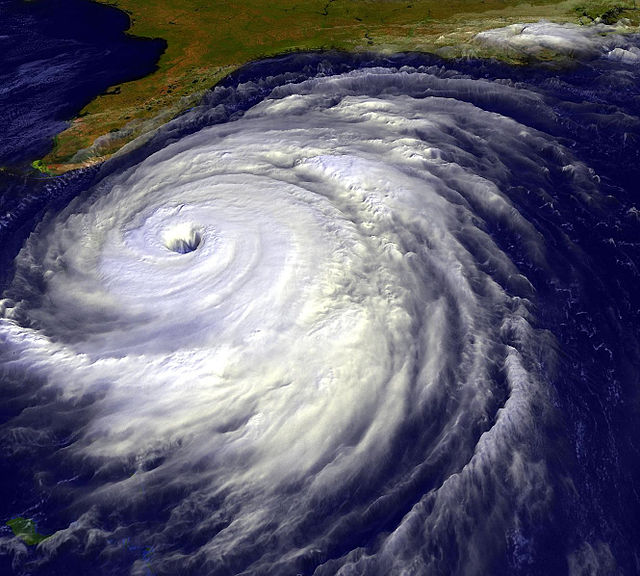
Hurricane Floyd over the Abaco Islands on September 14
Visual comparison of Hurricane Floyd with Hurricane Andrew while at similar positions and nearly identical intensities
Hurricane Floyd on September 14, 1999
Beach erosion in Cocoa Beach