El Greco
Videos
Doménikos Theotokópoulos, most widely known as El Greco, was a Greek painter, sculptor and architect of the Spanish Renaissance, regarded as one of the greatest artists of all time. El Greco was a nic
Portrait of a Man, a presumed self-portrait c. 1595–1600, Metropolitan Museum of Art

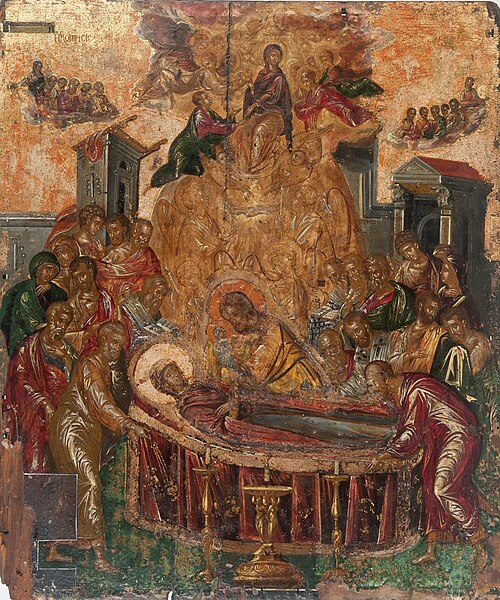
The Dormition of the Virgin (before 1567, tempera and gold on panel, 61.4 × 45 cm, Holy Cathedral of the Dormition of the Virgin, Hermoupolis, Syros) was probably created near the end of the artist's Cretan period. The painting combines post-Byzantine and Italian mannerist stylistic and iconographic elements.

The Adoration of the Magi (1565–1567, 56 × 62 cm, Benaki Museum, Athens). The icon, signed by El Greco ("Χείρ Δομήνιχου", Created by the hand of Doménicos), was painted in Candia on part of an old chest.

Adoration of the Magi, 1568, Museo Soumaya, Mexico City
The Burial of the Count of Orgaz is a 1586 painting by El Greco, a prominent Renaissance painter, sculptor, and architect of Greek origin. Widely considered among his finest works, it illustrates a po
El Greco
…and to have established a workshop capable of producing altar frames and statues as well as paintings. On 12 March 1586 he obtained the commission for The Burial of the Count of Orgaz, now his best-known work. The decade 1597 to 1607 was a period of intense activity for El Greco. During these years he received several major commissions…

El Greco The Burial of the Count of Orgaz

Detail of the painting

Detail of the painting, showing El Greco

Detail of the painting.