Emperor Wu of Han
Videos
Emperor Wu of Han, personal name Liu Che and courtesy name Tong, was the seventh emperor of the Han dynasty from 141 to 87 BC. His reign lasted 54 years – a record not broken until the reign of the Ka
Emperor Wu with two attendants

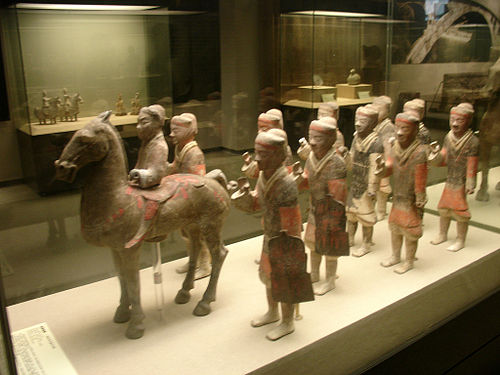
Chinese ceramic statues of cavalry and infantry, wearing armour and bearing shields (with missing weapons), from the Yangjiawan terracotta army, Hainan Provincial Museum

Ceramic statues of a prancing horse (foreground) and a cavalryman on horseback (background), Eastern Han dynasty (25–220 AD)

A scene of historic paragons of filial piety conversing with one another, Chinese painted artwork on a lacquered basketwork box, excavated from an Eastern-Han tomb of what was the Chinese Lelang Commandery in present-day North Korea
Emperor Zhao of Han
Videos
Emperor Zhao of Han, born Liu Fuling, was the eighth emperor of the Han dynasty from 87 to 74 BC. Emperor Zhao was the youngest son of Emperor Wu.
Emperor Wu of Han
…These witchcraft persecutions later became intertwined in succession struggles and erupted into a major catastrophe. In 94 BC, Emperor Wu's youngest son Liu Fuling was born to a favorite concubine of his, Lady Gouyi (Consort Zhao). Emperor Wu was ecstatic in having a child at such an advanced age (62 years old…

Depiction of Emperor Zhao by Yan Liben, Tang dynasty

The story of Jin Midi. Wu Liang shrines, Jiaxiang, Shandong province, China. 2nd century AD. Ink rubbings of stone-carved reliefs as represented in Feng Yunpeng and Feng Yunyuan, Jinshi suo (1824 edition), n.p.

Pingling, tomb of Emperor Zhao, in Xianyang, Shaanxi