Endeavour is an impact crater located in the Meridiani Planum extraterrestrial plain within the Margaritifer Sinus quadrangle (MC-19) region of the planet Mars. Endeavour is about 22 kilometers (14 mi) in diameter. Using Mars Reconnaissance Orbiter data, phyllosilicate-bearing outcrops have been detected along its rim. These minerals may have formed under wet conditions in a low-acidic environment during the early history of Mars. There are raised rim segments to the north, east, and southwest. The rim has become worn, rounded and degraded, with infilling of plains material in a manner similar to the Victoria crater.
Endeavour as viewed from Mars orbit
Opportunity images a Martian whirlwind on the floor of Endeavour (April 2016)
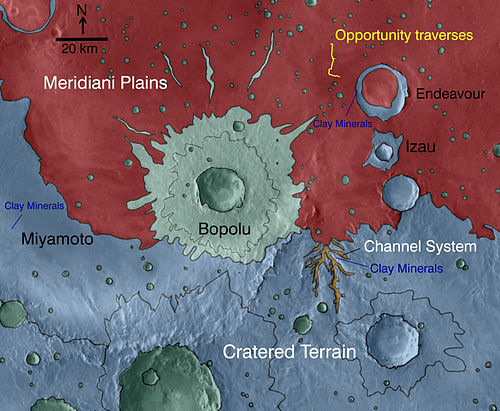
Colored for minerals. Opportunity traverse is dated to 2010 while it was still on its way to Endeavour. The coloring is based on geological information as observed by the Mars Reconnaissance Orbiter CRISM instrument
Meridiani Planum (alternatively Terra Meridiani) is a large plain straddling the equator of Mars. The plain sits on top of an enormous body of sediments that contains a lot of bound water. The iron oxide in the spherules is crystalline (grey) hematite (Fe2O3).
Mars Exploration Rover Opportunity looks across the smooth soil of Meridiani Planum, towards the discarded heat shield of the rover's lander
The unfolded, empty lander for the rover Opportunity after completing the "hole-in-one" landing inside Eagle Crater.
Figure 4. The plain at a field of "plains ripples" soils. Fields of plains ripples cover many square kilometers. The hills on the horizon are the rim of Endeavour Crater. Each plains ripple is a sloped mound of soil, usually around 25 cm tall, 2 m to 4 m wide, and longer than they are wide. The ripples' long axes are roughly aligned north-to-south since the prevailing winds are (like the equatorial trade winds on Earth) from east to west. Each ripple can join with others or be separated by patches of lighter Meridiani sediment outcrop (for example, in the left foreground). A scattering of loose blocks sits on the foreground sediment. Most block are ejecta from meteorite impacts. Plains ripples are smaller than dunes, "armored" by a layer of hematite spherules, and, hence, have exceedingly slow migration rates.